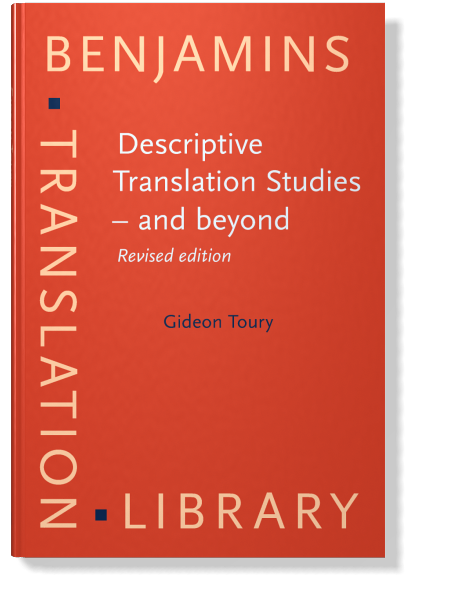
In:Descriptive Translation Studies – and beyond: Revised edition
Gideon Toury
[Benjamins Translation Library 100] 2012
► pp. v–x
Get fulltext
This article is available free of charge.
Published online: 21 November 2012
https://doi.org/10.1075/btl.100.toc
https://doi.org/10.1075/btl.100.toc
Table of contents
Introduction: A case for Descriptive Translation Studies
Part I. The pivotal position of Descriptive Studies and DTS
Part II. A rationale for Descriptive Translation Studies
1. Translations as facts of a ‘target’ culture: An assumption and its methodological implications
2. The notion of ‘problem’ in Translation Studies
Excursus A. Pseudotranslations and their significance
3. Being a norm-governed activity
4. Studying translational norms
5. Constituting a method for Descriptive Studies
6. The coupled pair of replacing + replaced segments
7. An exemplary ‘study in Descriptive Studies’: Conjoint phrases as translational replacements
Part III. Translation-in-context: An assortment of case studies143
8. Between ‘Golden Poems’ and Shakespearean sonnets
9. A lesson from indirect translation
10. Literary organization and translation strategies: A text is sifted through a mediating model
Excursus B. ‘Translation of literary texts’ vs. ‘literary translation’
11. Studying interim solutions: Possibilities and implications
12. A translation comes into being: Hamlet’s monologue in Hebrew
13. Translation-specific lexical items and their lexicographical treatment
14. Experimentation in Translation Studies: Achievements, prospects and some pitfalls
Excursus C. A bilingual speaker becomes a translator: A sketch of a developmental model
Part IV. Beyond Descriptive Studies: Towards some laws of translational behaviour
References
Name index
Subject index
