In:L3 Syntactic Transfer: Models, new developments and implications
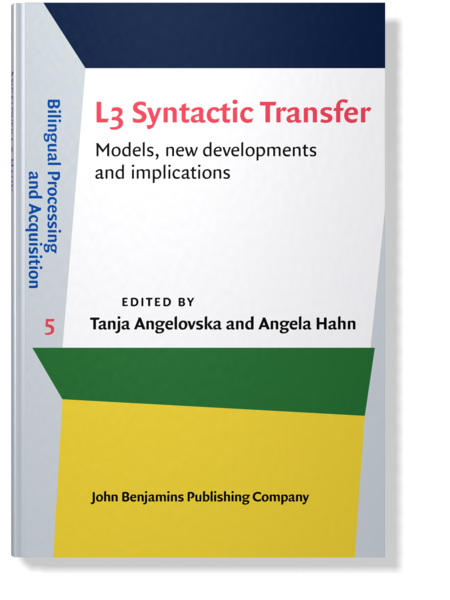
Edited by Tanja Angelovska and Angela Hahn
[Bilingual Processing and Acquisition 5] 2017
► pp. 299–319
Chapter 13Input-Practice-Output
A method for teaching L3 English after L2 German with a focus on syntactic transfer
Published online: 15 August 2017
https://doi.org/10.1075/bpa.5.14hah
https://doi.org/10.1075/bpa.5.14hah
Abstract
In the field of Instructed Third Language Acquisition (ITLA), teachers are left alone not knowing how to predict possible transfer phenomena, how to overcome them and how to raise their learners’ metalinguistic awareness. We start from the existing results and non-results of L3 acquisition (transfer) and develop practical applications as part of the Input-Practice-Output Method showing that a combination of these three phases allows for an individual, learner-centered and teacher’s awareness-based framework in ITLA. We offer implications for designing teaching materials, planning lessons for multilingual classrooms and for classroom action research.
Article outline
- Introduction
- Starting point: Previous implications for L3 teaching
- Teaching and learning framework
- Action research approach
- Flipped Classroom approach
- Applications of the IPO-method
- The INPUT-Phase of the IPO-method
- The PRACTICE-phase of the IPO-method
- Activity 1: Scramble sentence-constituents
- Activity 2: Card-Matching “pictures” with “adverbials”
- Activity 3: Matching pictures with oral input sentences / discourse
- The OUTPUT phase of the IPO-method
- Activity 1: Describing silent acting out
- Activity 2: Retelling
- Activity 3: Picture-based retelling
- Implications
- Implications for the development of language teaching materials
- Implications for lesson planning
- Implications for classroom research
- Conclusion
Acknowledgements Notes References

References (38)
Allgäuer-Hackl, E., & Jessner, U. (2013). Mehrsprachigkeitsunterricht aus mehrsprachiger Sicht. Zur Förderung des metalinguistischen Bewusstseins. In E. Vetter (Ed.), Professionalisierung für sprachliche Vielfalt. Die Ausbildung von Sprachenlehrer/innen (pp. 111–147). Hohengehren: Schneider.
Angelovska, T., & Benati, A. G. (2013). Processing instruction and the age factor: Can adults and school-age native speakers of German process English simple past tense correctly? In J. F. Lee & A. Benati (Eds.), Individual differences and Processing Instruction (pp. 131–152). Sheffield: Equinox.
Angelovska, T., & Hahn, A. (2012). Written L3 (English): Transfer phenomena of L2 (German) lexical and syntactical properties. In D. Gabrys-Barker (Ed.), Crosslinguistic influences in multilingual language acquisition (pp. 23–40). Heidelberg: Springer.
(2013). Raising language awareness for learning and teaching L3 grammar. In A. Benati, C. Laval, & M. Arche (Eds.), The grammar dimension in instructed second language learning (pp. 185–207). London: Bloomsbury Academic.
Angelovska, T. (2017). (When) do L3 English learners transfer from L2 German? Evidence from spoken and written data by L1 Russian speakers. In T. Angelovska & A. Hahn (Eds.), L3 syntactic transfer: Models, new developments and implications (Bilingual Processing and Acquisition 5). Amsterdam: John Benjamins.
Benati, A., & Angelovska, T. (2015). The effects of processing instruction on the acquisition of English simple past tense: Age and cognitive task demands. International Review of Applied Linguistics in Language Teaching (IRAL), 53(2), 249–269. .
Bergmann, J., & Sams, A. (2012). Flip your classroom: Reach every student in every class every day. Eugene OR: International Society for Technology in Education.
Burns, A. (2007). Action research: Contributions and further directions in ELT. In J. Cummins, & C. Davison (Eds.), International handbook of English language teaching, Part II. Berlin: Springer Science+Business Media LLC.
Cenoz, J. (2001). The effect of linguistic distance, L2 status and age on cross-linguistic influence in third language acquisition. Cross-Linguistic Influence in Third Language Acquisition: Psycholinguistic Perspectives, 111(45), 8–20.
Dalton-Puffer, C., Faistauer, R., & Vetter, E. (2011). Research on language teaching and learning in Austria (2004–2009). Language Teaching, 44(2), 181–211. .
(2012). Teachers’ beliefs about the role of prior language knowledge in language learning. International Journal of Multilingualism, 8(3), 216–234. .
Gass, S. M., & Selinker, L. (Eds.). (1983). Language transfer in language learning. Issues in second language research. Rowley, MA: Newbury House.
González Alonso, J., & Rothman, J. (2017). From theory to practice in multilingualism: What theoretical research implies for third language learning. In T. Angelovska & A. Hahn (Eds.), L3 Syntactic Transfer: Models, New Developments and Implications (Bilingual Processing and Acquisition 5). Amsterdam: John Benjamins.
Hufeisen B., & Neuner, G. (Eds.). (2003). Mehrsprachigkeitskonzept – Tertiarsprachen – Deutsch nach Englisch. Strasbourg: Council of Europe Publishing.
Jenkins, J. (2015). Repositioning English and multilingualism in English as a Lingua Franca. Englishes in Practice, 2(3), 49–85. .
Jessner, U. (2008). Teaching third languages: Findings, trends and challenges. Language Teaching, 41(1), 15–56. .
Klieme, E. (2006). Zusammenfassung zentraler Ergebnisse der DESI-Studie. Retrieved from <[URL] (2 May 2016).
Lage, M. J., Platt, G. J., & Treglia, M. (2000). Inverting the classroom: A gateway to creating an inclusive learning environment. The Journal of Economic Education, 31(1), 30–43. .
Muñoz, C. (2011) Is input more significant than starting age in foreign language acquisition? International Review of Applied Linguistics (IRAL), 49(2), 113–133. .
Muñoz, C., & Singleton, D. (2011) A critical review of age-related research on L2 ultimate attainment. Language Teaching, 44(1), 1–35. .
Piske, T., & Young-Scholten, M. (Eds.). (2008). Input matters in SLA. Bristol: Multilingual Matters.
Rothman, J. (2010). On the typological economy of syntactic transfer: Word order and relative clause high/low attachment preference in L3 Brazilian Portuguese. International Review of Applied Linguistics in Language Teaching (IRAL), 48(2–3), 245–273. .
(2011). L3 syntactic transfer selectivity and typological determinacy: The Typological Primacy Model. Second Language Research, 27(1), 107–127. .
Rothman, J., & Cabrelli Amaro, J. (2010). What variables condition syntactic transfer? A look at the L3 initial state. Second Language Research, 26(2), 189–218. .
Sharwood-Smith, M. (2009). A MOGUL perspective on consciousness and input processing. Plenary presentation given at the 2009 conference on Second Language Processing and Parsing: State of the Science. Texas State University. Retrieved from <[URL]>
Sharwood Smith, M., & Kellerman, E. (Eds.). (1986). Crosslinguistic influence in second language acquisition. Oxford: Pergamon Institute of English.
Sharwood-Smith, M., & Truscott, J. (2014). Explaining input enhancement: A MOGUL perspective. International Review of Applied Linguistics in Language Teaching (IRAL), 52(3), 253–281. .
Stöckl, H., & Klug, N.-M. (2014). Sprache im multimodalen Kontext. In E. Felder & A. Gardt (Eds.), Handbuch Sprache und Wissen (HB Sprachwissen 1) (pp. 242–264). Berlin: De Gruyter.
Thornbury, S. (2006). An AZ of ELT: A dictionary of terms and concepts. Macmillan Books. Oxford: Macmillian.
Truscott, J., & Sharwood Smith, M. (2004). Acquisition by processing: A modular approach to language development. Bilingualism: Language and Cognition, 7(1), 1–20. .
Ullmann, J., & Hahn, A. (2016). Integration von Erklärvideos in einen Englisch Selbstlernkurs. In C. Becker, G. Blell, & A. Rössler (Eds.), Web 2.0 und Komplexe Kompetenzaufgaben im Fremdsprachenunterricht. Bern: Peter Lang.
VanPatten, B. (2015). Processing perspectives on pedagogical intervention. In J. W. Schwieter (Ed.), The Cambridge handbook of bilingual processing (pp. 200–215). Cambridge: CUP.
Wright, T. (2002). Doing language awareness: Issues for language study in language teacher education. In H. Trappes-Lomax & G. Ferguson (Eds.), Language in language teacher education (Language Learning & Language Teaching 4). Amsterdam: John Benjamins.
Cited by (9)
Cited by nine other publications
Xu, Yaqiong & Anna Krulatz
Angelovska, Tanja & Katrin Schaipp
Rothman, Jason, Jorge González Alonso & Eloi Puig-Mayenco
Angelovska, Tanja
2017. (When) do L3 English learners transfer from L2 German?. In L3 syntactic transfer [Bilingual Processing and Acquisition, 5], ► pp. 195 ff.
Angelovska, Tanja
Angelovska, Tanja
Angelovska, Tanja
Angelovska, Tanja
2021. When a psycholinguist enters the multilingual classroom. In English Pronunciation Instruction [AILA Applied Linguistics Series, 19], ► pp. 39 ff.
This list is based on CrossRef data as of 15 november 2025. Please note that it may not be complete. Sources presented here have been supplied by the respective publishers. Any errors therein should be reported to them.