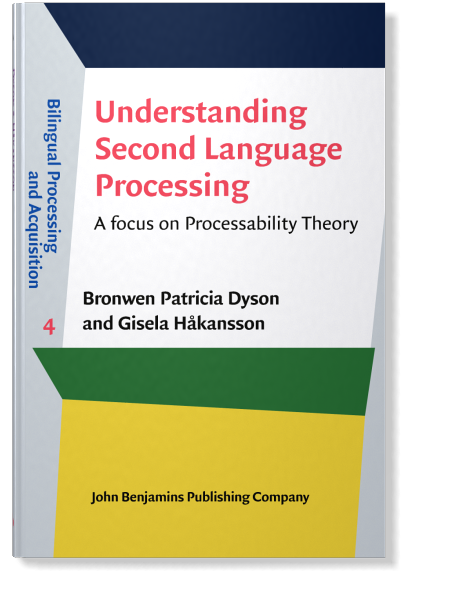
In:Understanding Second Language Processing: A focus on Processability Theory
Bronwen Patricia Dyson and Gisela Håkansson
[Bilingual Processing and Acquisition 4] 2017
► pp. vii–x
Get fulltext
This article is available free of charge.
Published online: 24 May 2017
https://doi.org/10.1075/bpa.4.toc
https://doi.org/10.1075/bpa.4.toc
Table of contents
Acknowledgements
Chapter 1Introduction
1.1Introduction
1.2Developmental sequences and PT
1.3L2 development and developmental stages
1.4Methodology and data: What is emergence?
1.5How PT relates to some key SLA concepts
1.6The typological challenge
1.7Different learner categories
1.8Tracking L2 variation
1.9Applications to language pedagogy and assessment
1.10Conclusion
Chapter 2L2 development of English
2.1Introduction
2.2Foundations of the ESL stages
2.2.1The SAMPLE project: Grammatical progressions
2.2.2The Pienemann and Johnston stages
2.2.3General developmental stages
2.3PT’s morphological stages for L2 English
2.3.1ESL morphological development: The PT account
2.3.2PT’s ESL morphological stages
2.3.3Studies of PT’s morphological stages
2.4PT’s syntactic stages for L2 English
2.4.1ESL syntactic development: The PT account
2.4.2PT’s ESL syntactic stages
2.4.3Studies of PT’s syntactic stages
2.4.4New theoretical underpinning
2.5New directions in ESL processing
2.5.1What is the shape of the ESL stages?
2.5.2What is the relationship between syntax and morphology in processing?
2.5.3Do the spoken stages apply to other skills?
2.6Conclusion
Chapter 3L2 development of Scandinavian languages
3.1Introduction
3.2Swedish as a target language: Morphology and syntax
3.2.1Morphology
3.2.1.1Noun phrase morphology
3.2.1.2Verb phrase morphology
3.2.2Syntax
3.3Pre-PT studies of Scandinavian languages as L2s
3.3.1Studies on SSL Syntax
3.3.1.1Target placement of negation
3.3.2Studies on SSL morphology
3.3.2.1Noun phrase agreement
3.3.3Summary of SSL research before PT
3.4Applying Processability Theory to Swedish
3.4.1PT’s predictions for L2 Swedish morphology
3.4.2Testing PT morphological stages on empirical SSL data
3.4.3PT’s predictions for L2 Swedish syntax
3.4.4Testing PT syntax stages on empirical SSL data
3.5Studies after 1998, applying Processability Theory
3.5.1Scandinavian L2 acquisition
3.5.2Second and foreign language acquisition of Swedish
3.6New directions
3.6.1Relationship between language teachers’ assessment and PT stages
3.6.2Relationship between syntax and morphology
3.7Conclusion
Chapter 4The typological challenge in PT
4.1Introduction
4.2Language classifications
4.2.1Language families
4.2.2Morphological typology
4.2.3Configurational and non-configurational languages
4.2.4Head- and dependent-marking
4.2.5External and internal structures
4.3The seventeen target languages analysed with the PT framework
4.3.1Examples of structures selected for PT analysis
4.4Pidgins and creoles through the PT lens
4.5PT and the typology of first languages
4.5.1Background languages in L2 learners of Swedish
4.5.2Backgound languages in L2 learners of Russian
4.5.3DMTH and typology of background languages
4.6Challenges for comparability
4.6.1At which stage are possessive structures placed?
4.6.2What counts as evidence of agreement?
4.6.3What counts as evidence for the subordination procedure?
4.6.4Data analyses
4.7Conclusion
Chapter 5Learner categories and PT
5.1Introduction
5.2Second language acquisition
5.2.1PT applied to second versus foreign language learners
5.2.2Instructed versus non-instructed learning in a second language setting
5.2.3Deaf learners of written L2 Swedish
5.3First language acquisition
5.3.1PT studies on monolingual acquisition
5.3.2PT studies on bilingual L1 acquisition
5.3.3PT studies on heritage learners/ speakers
5.3.4Children with Language Impairment – PT as diagnostic tool
5.4Conclusion
Chapter 6Variation in processing
6.1Introduction
6.2Origins: Learner variation in developmental stages
6.2.1The principle of simplification
6.2.2Variation in the Multidimensional Model
6.2.3Variation in Pienemann’s early work
6.2.4Variation in the Predictive Framework
6.3Syntactic variation in Processability Theory
6.3.1Hypothesis Space and syntactic conflicts
6.3.2Responding to syntactic problems: The options and trailers of learner types
6.3.3Research on PT’s hypothesis on syntactic variation
6.4Morphological variation in Processability Theory
6.4.1Hypothesis Space and morphological conflicts
6.4.2Responding to morphological problems: Options and trailers of learner types
6.4.3Research on PT’s hypothesis on morphological variation
6.5Variation in developmental features
6.5.1Variation in L2 English developmental features
6.5.2Variation in other L2s’ developmental features
6.5.3Other approaches to variation in developmental features
6.6Conclusion
Chapter 7Language teaching, assessment and processing
7.1Introduction
7.2Teachability and language assessment: Foundations
7.2.1The Teachability Hypothesis
7.2.2The Teachability Hypothesis: Cross-linguistic studies
7.2.3Developmental assessment: Foundations
7.3Teachability and language assessment in PT
7.3.1The Teachability Hypothesis in PT
7.3.2PT and cross-linguistic studies of teachability
7.3.3Developmental assessment in PT
7.4Processing and the pedagogical context
7.4.1Processing and syllabus/curriculum design
7.4.2Processing and textbook design
7.4.3Processing and teacher talk
7.5New directions in developmentally moderated pedagogy
7.5.1Influence of instructional factors on processing
7.5.2Developmentally moderated cycles
7.5.3The roles of form and meaning in developmentally-moderated pedagogy
7.5.4Diagnostic procedures for L2s other than English
7.6Conclusion
Chapter 8Conclusion
8.1Introduction
8.2The universality of the PT’s stages
8.4Patterned variation within development
8.5The constraints and potential of developmental readiness
8.6Overall implications
8.9Concluding remarks
References
Appendix
Index
