Article published In: Computational Construction Grammar and Constructional Change
Edited by Katrien Beuls and Remi van Trijp
[Belgian Journal of Linguistics 30] 2016
► pp. 1–13
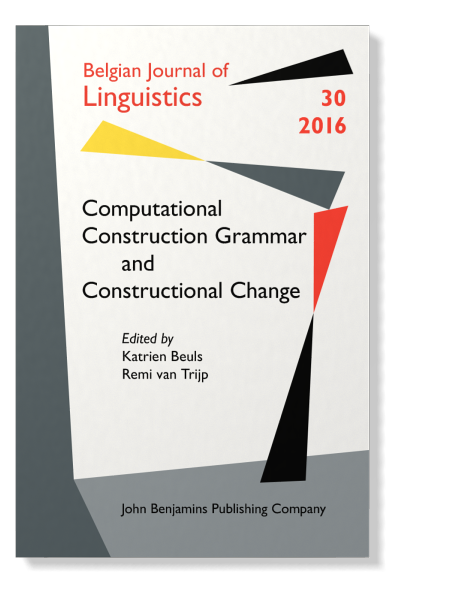
Computational construction grammar and constructional change
Published online: 10 January 2017
https://doi.org/10.1075/bjl.30.01beu
https://doi.org/10.1075/bjl.30.01beu

References (77)
Arbib, Michael. 2012. How the Brain Got Language: The Mirror System Hypothesis. Oxford: Oxford University Press.
Barðdal, Jóhanna, Elena Smirnova, Lotte Sommerer, and Spike Gildea (eds). 2015. Diachronic Construction Grammar. Amsterdam: John Benjamins.
Beckner, Clay, Richard Blythe, Joan Bybee, Morten H. Christiansen, William Croft, Nick C. Ellis, John Holland, Jinyun Ke, Diane Larsen-Freeman, and Tom Schoenemann. 2009. “Language Is a Complex Adaptive System: Position Paper.” Language Learning 59(s1): 1–26.
Bergen, Benjamin K. and Nancy Chang. 2005. “Embodied Construction Grammar in Simulation-Based Language Understanding.” In Construction Grammars: Cognitive Grounding and Theoretical Extensions, ed. by Jan-Ola Östman and Mirjam Fried, 147–190. Amsterdam: John Benjamins.
Beuls, Katrien and Luc Steels. 2013. “Agent-Based Models of Strategies for the Emergence and Evolution of Grammatical Agreement.” PLoS ONE 8 (3): e58960.
Boas, Hans C. and Ivan A. Sag (eds). 2012. Sign-based Construction Grammar. Stanford: CSLI Publications.
Bybee, Joan. 1985. Morphology: A Study on the Relation Between Meaning and Form. Amsterdam: John Benjamins.
Coussé, Evie and Ferdinand von Mengden (eds). 2014. Usage-Based Approaches to Language Change. Amsterdam: John Benjamins.
Croft, William. 1991. Syntactic Categories and Grammatical Relations. The Cognitive Organization of Information. Chicago University Press.
Daelemans, Walter, Antal van den Bosch, and Jakub Zavrel. 1999. “Forgetting Exceptions is Harmful in Language Learning.” Machine Learning 34 (1/3): 1143.
Daems, Jocelyne, Eline Zenner, Kris Heylen, Dirk Speelman, and Hubert Cuyckens (eds). 2015. Change of Paradigms – New Paradoxes: Recontextualizing Language and Linguistics. Berlin/New York: Mouton De Gruyter.
Diessel, Holger. 2015. “Usage-Based Construction Grammar.” In Handbook of Cognitive Linguistics, ed. by Ewa Dabrowska and Dagmar Divjak, 295–321. Berlin: Mouton de Gruyter.
Dunn, Michael, Simon J. Greenhill, C. Levinson, Stephen, and Russel D. Gray. 2011. “Evolved structure of language shows lineage-specific trends in word-order universals.” Nature 4731: 79–82.
Dunn, Michael, Angela Terrill, Ger Reesink, Robert A. Foley, and Stephen C. Levinson. 2005. “Structural phylogenetics and the reconstruction of ancient language history.” Science 309 (5743): 2072–2075.
Fillmore, Charles J. 1988. “The Mechanisms of “Construction Grammar”.” In Proceedings of the Fourteenth Annual Meeting of the Berkeley Linguistics Society, 35–55. Berkeley CA: Berkeley Linguistics Society.
Fillmore, Charles J., Paul Kay, and Mary Catherine O’Connor. 1988. “Regularity and Idiomaticity in Grammatical Constructions: The Case of Let Alone.” Language 64 (3): 501–538.
Fried, Mirjam. 2009. “Construction Grammar as a Tool for Diachronic Analysis.” Constructions and Frames 1 (2): 261–290.
Geeraerts, Dirk. 1985. Paradigm and Paradox: Explorations Into a Paradigmatic Theory of Meaning and its Epistemological Background. Leuven: Leuven University Press.
Glynn, Dylan and Kerstin Fischer (eds). 2010. Quantitative Methods in Cognitive Semantics: Corpus-Driven Approaches. Berlin/New York: Mouton De Gruyter.
Goldberg, Adele E. 1995. A Construction Grammar Approach to Argument Structure. Chicago: Chicago UP.
Goldberg, Adele E., Devin M. Casenhiser, and Nitya Sethuraman. 2004. “Learning Argument Structure Generalizations.” Cognitive Linguistics 15 (3): 289–316.
Gray, Russel D. and Quentin D. Atkinson. 2003. “Language-tree divergence times support the Anatolian theory of Indo-European origin.” Nature 4261: 435–439.
Gries, Stefan Th. 2015. “The Role of Quantitative Methods in Cognitive Linguistics: Corpus and Experimental Data on (Relative) Frequency and Contingency of Words and Constructions.” In Change of Paradigms – New Paradoxes: Recontextualizing Language and Linguistics, ed. by Jocelyne Daems, Eline Zenner, Kris Heylen, Dirk Speelman, and Hubert Cuyckens, 311–325. Berlin/New York: Mouton De Gruyter.
Hale, John T. 2003. “The Information Conveyed by Words in Sentences.” Journal of Psycholinguistic Research 32 (2): 101–123.
Hall, David and Dan Klein. 2010. “Finding Cognate Groups Using Phylogenies.” In Proceedings of the 48th Annual Meeting of the Association for Computational Linguistics, 1030–1039. Uppsala: ACL.
Halliday, Michael A. K. and Ruqaiya Hasan. 1985. Language, Context and Text: Aspects ofLanguage in a Social Semiotic Perspective. Geelong: Deakin University Press.
Heggarty, Paul, Warren Maguire, and April McMahon. 2010. “Splits or waves? Trees or webs? How divergence measures and network analysis can unravel language histories.” Philosophical Transactions of the Royal Society 365: 38293843.
Holland, John. 2006. “Studying Complex Adaptive Systems.” Journal ofSystems Science and Complexity 19 (1): 1–8.
Hollmann, Willem B. and Anna Siewierska. 2011. “The Status of Frequency, Schemas, and Identity in Cognitive Sociolinguistics: A Case Study on Definite Article Reduction.” Cognitive Linguistics 221: 25–54.
Hopper, Paul. 1987. “Emergent grammar.” In Proceedings of the 13th Annual Meeting of the Berkeley Linguistics Society, ed. by Jon Aske, Natasha Beery, Laura Michaelis, and Hana Filip, 139–157. Berkeley CA: Berkeley Linguistics Society.
Hopper, Paul and Elizabeth Traugott. 1993. Grammaticalization. Cambridge: Cambridge University Press.
Hurford, James. 1989. “Biological Evolution of the Saussurean Sign as a Component of the Language Acquisition Device.” Lingua 77 (2): 187–222.
Jaeger, T. Florian and Harry Tily. 2011. “On Language ‘Utility’: Processing Complexity and Communicative Efficiency.” WIREs: Cognitive Science 2 (3): 323–335.
Johansen, Mark K. and Thomas J. Palmeri. 2002. “Are There Representational Shifts During Category Learning?.” Cognitive Psychology 451: 482–553.
Jurafsky, Dan. 1996. “A Probabilistic Model of Lexical and Syntactic Access and Disambiguation.” Cognitive Science 201: 137–194.
Kay, Paul and Charles J. Fillmore. 1999. “Grammatical Constructions and Linguistic Generalizations: The What’s X Doing Y? Construction.” Language 751: 1–33.
Kondrak, Grzegorz. 2002. Algorithms for Language Reconstruction. Ph. D. thesis, University of Toronto.
Labov, William. 2000. Principles of Linguistic Change. Volume 2: Social Factors. Oxford: Basil Blackwell.
Langacker, Ronald W. 1987. Foundations of Cognitive Grammar: Theoretical Prerequisites. Stanford: Stanford University Press.
2000. “A Dynamic Usage-Based Model.” In Usage-Based Models ofLanguage, ed. by Michael Barlow and Suzanne Kemmer, 1–63. Chicago: Chicago University Press.
Perek, Florent. 2015. Argument Structure in Usage-Based Construction Grammar, Volume 17 of Constructional Approaches to Language. John Benjamins: John Benjamins.
Pijpops, Dirk, Katrien Beuls, and Freek Van de Velde. 2015. “The Rise of the Verbal Weak Inflection in Germanic: An agent-Based Model.” Computational Linguistics in the Netherlands Journal 51: 81–102.
Pleyer, Michael and Nicolas Lindner. 2014. “Constructions, Construal and Cooperation in the Evolution of Language.” In The Evolution of Language: Proceedings of the 10th International Conference, ed. by Erica A. Cartmill, Sean Roberts, Heidi Lyn, and Hannah Cornish, 244–251. Singapore: World Scientific Publishing.
Rice, Sally and John Newman (eds). 2010. Empirical and Experimental Methods in Cognitive/Functional Research. Stanford: CSLI Publications.
Rosch, Eleanor and Barbara B. Lloyd (eds). 1978. Cognition and Categorization. Hillsdale NJ: Lawrence Erlbaum.
Schneider, Nathan and Reut Tsarfaty. 2013. “Book Review: Design Patterns in Fluid Construction Grammar.” Computational Linguistics 39 (2): 447–453.
Smith, Andrew D.M. 2014. “Models of Language Evolution and Change.” Wiley Interdisciplinary Reviews: Cognitive Science 5 (3): 281–293.
Spranger, Michael. 2013. “Evolving Grounded Spatial Language Strategies.” KI – Künstliche Intelligenz 27 (2): 97–106.
. 2000. “Language as a Complex Adaptive System.” In Proceedings of PPSN VI: Lecture notes in Computer Science, ed. by Mark Schoenauer, Lecture Notes in Computer Science, 17–26. Berlin: Springer-Verlag.
. 2004. “Constructivist Development of Grounded Construction Grammars.” In Proceedings 42nd Annual Meeting of the Association for Computational Linguistics, ed. by Walter Daelemans, 9–19. Barcelona: ACL.
(ed). 2011. Design Patterns in Fluid Construction Grammar. Amsterdam: John Benjamins.
(ed). 2012a. Experiments in Cultural Language Evolution. Amsterdam: John Benjamins.
. 2012b. “Self-Organization and Selection in Cultural Language Evolution.” In Experiments in Cultural Language Evolution, ed. by Luc Steels, 1–37. Amsterdam: John Benjamins.
. 2015. The Talking Heads Experiment: Origins of Words and Meanings, Volume 1 of Computational Models of Language Evolution. Berlin: Language Science Press. Open access at [URL].
Steels, Luc and Eörs Szathmáry. 2016. “Fluid Construction Grammar as a Biological System.” Linguistics Vanguard 2 (1).
Steiner, Lydia, Peter F. Stadler, and Michael Cysouw. 2011. “A Pipeline for Computational Historical Linguistics.” Language Dynamics and Change 1 (1): 89127.
Tomasello, Michael. 2003. Constructing a Language. A Usage Based Theory of Language Acquisition. Harvard University Press.
Traugott, Elizabeth Closs and Graeme Trousdale. 2013. Constructionalization and Constructional Changes. Oxford: Oxford University Press.
Van de Velde, Freek. 2014. “Degeneracy: The maintenance of constructional networks.” In Extending the Scope of Construction Grammar, ed. by Ronny Boogaart, Timothy Colleman, and Gijsbert Rutten, Volume 11, 141–179. Berlin: Mouton De Gruyter.
van Trijp, Remi. 2010a. “Grammaticalization and Semantic Maps: Evidence from Artificial Language Evolution.” Linguistic Discovery 8 (1): 310–326.
. 2010b. “Strategy Competition in the Evolution of Pronouns: A Case-Study of Spanish Leísmo, Laísmo and Loísmo.” In The Evolution of Language (EVOLANG 8), ed. by Andrew D.M. Smith, Marieke Schouwstra, Bart de Boer, and Kenny Smith, 336–343. Singapore: World Scientific.
. 2013a. “A Comparison Between Fluid Construction Grammar and Sign-Based Construction Grammar.” Constructions and Frames 5 (1): 88–116.
. 2013b. “Linguistic Assessment Criteria for Explaining Language Change: A Case Study on Syncretism in German Definite Articles.” Language Dynamics and Change 3 (1): 105–132.
. 2015. “Cognitive vs. Generative Construction Grammar: The Case of Coercion and Argument Structure.” Cognitive Linguistics 261: 613–632.
Cited by (4)
Cited by four other publications
Garcia-Varela, Francisco, Zvi Bekerman, Miguel Nussbaum, Marcelo Mendoza & Joaquin Montero
Noël, Dirk
2019. The decline of the Deontic nci construction in Late Modern English. Cognitive Linguistic Studies 6:1 ► pp. 22 ff.
Pijpops, Dirk, Isabeau De Smet & Freek Van de Velde
2018. Constructional contamination in morphology and syntax. Constructions and Frames 10:2 ► pp. 269 ff.
Pijpops, Dirk
2017. Jiyoung Yoon & Stefan Th. Gries (eds.). 2016.Corpus-based Approaches to Construction Grammar. Constructions and Frames 9:2 ► pp. 329 ff.
This list is based on CrossRef data as of 19 november 2025. Please note that it may not be complete. Sources presented here have been supplied by the respective publishers. Any errors therein should be reported to them.