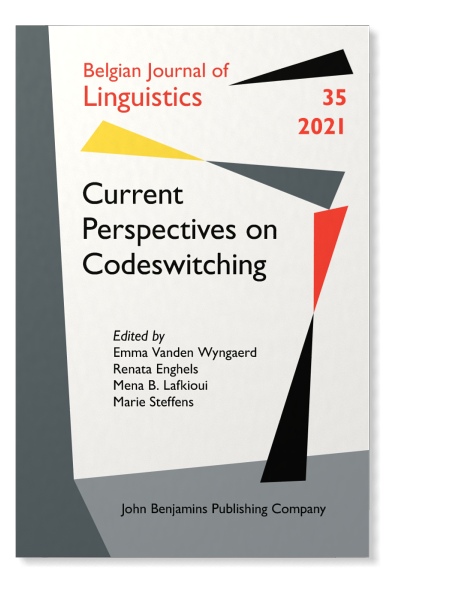
Article published In: Current Perspectives on Codeswitching:
Edited by Emma Vanden Wyngaerd, Renata Enghels, Mena B. Lafkioui and Marie Steffens
[Belgian Journal of Linguistics 35] 2021
► pp. 183–213
Diminutive constructions in bilingual speech
A case study of Spanish-English codeswitching
Published online: 15 February 2022
https://doi.org/10.1075/bjl.00068.van
https://doi.org/10.1075/bjl.00068.van
Abstract
The diminutive construction is formed and used differently in Spanish and English, which leads us to the question
how this construction with different morphosyntactic and semantic-pragmatic characteristics in the input languages is governed in
Spanish-English bilingual and codeswitching speech. Through the analysis of a dataset of diminutive constructions extracted from
the Bangor Miami corpus, this paper contributes to a better understanding of how one and the same construction differently
represented in the input languages is administered in bilingual contexts. As this is a first approach to studying diminutives in
codeswitching, three well known structural codeswitching models serve as a primary theoretical tool against which the diminutive
is tested. These are Poplack, Shana. 1980. “Sometimes
I’ll Start a Sentence in Spanish y termino en español: Toward a Typology of
Code-Switching.” Linguistics, 18 (7–8), 581–618. Universal Constraints, . 2002. Contact
Linguistics. Bilingual Encounters and Grammatical
Outcomes. Oxford: Oxford University Press. Matrix Language Frame Model, and Blom, Jan-Petter, and John Gumperz. 1972. “Social
Meaning in Linguistic Structures: Code Switching in Northern
Norway.” In Directions in Sociolinguistics: The Ethnography of
Communication, ed. by John Gumperz, and Del Hymes. 407–434. New York: Holt, Rinehart, and Winston. Metaphorical Codeswitching Framework. The results show that Miami bilinguals prefer the prototypical
markers of each language, -ito and little (e.g. un partimecito, un little
estante). Furthermore, while the data largely confirm Poplack’s Constraints, they refute our hypothesis based on
Myers-Scotton’s MLF model. Regarding Gumperz’ theory, the use of diminutive markers in a particular language correlates with a
certain meaning the speaker wants to communicate (i.e. quantitative or qualitative), which again provides support to the
framework.
Keywords: codeswitching, diminutive, English-Spanish, bilingualism, Bangor Miami corpus
Article outline
- 1.Introduction
- 2.The diminutive in monolingual and bilingual contexts
- 2.1The Spanish diminutive
- 2.2The English diminutive
- 2.3The diminutive in bilingual contexts and codeswitching theories
- 2.3.1Universal constraints
- 2.3.2Matrix language frame model
- 2.3.3Metaphorical codeswitching framework
- 3.Corpus and parameters
- 4.Data analysis and results
- 4.1Formal analysis of the bilingual diminutive construction
- 4.1.1Diminutive configuration
- 4.1.2Codeswitching patterns
- 4.2Empirical evaluation of codeswitching theories
- 4.2.1Universal constraints
- 4.2.2Diminutives and the matrix language hypothesis
- 4.2.3Language of the diminutive: Subjectification versus objectification
- 4.1Formal analysis of the bilingual diminutive construction
- 5.Discussion and conclusions
- Notes
- Glossary
References

References (56)
Aaron, Jessi Elana. 2004. “So respetamos un tradición
del uno al otro: So and Entonces in New Mexican Bilingual Discourse.” Spanish in
Context 1 (2): 161–179.
Auer, Peter. 1998. “From
Code-Switching via Language Mixing to Fused Lects: Toward a Dynamic Typology of Bilingual
Speech.“ Interaction and Linguistic
Structures 61: 1–30.
Belazi, Hedi M., E. J. Rubin, and Almeida Jacqueline Toribio. 1994. “Code
Switching and X-Bar Theory: The Functional Head Constraint.” Linguistic
Inquiry 251: 221–237.
Berk-Seligson, Susan. 1986. “Linguistic
Constraints on Intrasentential Code-Switching: A Study of Spanish/Hebrew
Bilingualism.” Language in
Society 15 (3): 313–348.
Betti, Silvia, and Renata Enghels. 2018. “Spanglish:
Current Issues, Future Perspectives, and Linguistic Insights.” In The
Oxford Handbook of Latino Studies, ed. by Ilan Stavans. 346–380. Oxford University Press.
Blom, Jan-Petter, and John Gumperz. 1972. “Social
Meaning in Linguistic Structures: Code Switching in Northern
Norway.” In Directions in Sociolinguistics: The Ethnography of
Communication, ed. by John Gumperz, and Del Hymes. 407–434. New York: Holt, Rinehart, and Winston.
Boztepe, Erman. 2003. “Issues
in Code-Switching: Competing Theories and Models.” Studies in Applied Linguistics &
TESOL 3 (2): 1–27.
Bullock, Barbara E., and Almeida Jacqueline Toribio. (eds.). 2009. The
Cambridge Handbook of Linguistic
Code-Switching. Cambridge: Cambridge University Press.
Callahan, Laura. 2002. “The
Matrix Language Frame Model and Spanish/English Codeswitching in Fiction.” Language &
Communication 22 (1): 1–16.
. 2004. Spanish/English
Code-Switching in a Written Corpus. Amsterdam: John Benjamins.
Chan, Brian Hok-Shing. 2008. “Code-Switching, Word
Order and the Lexical/Functional Category
Distinction.” Lingua 118 (6): 777–809.
Deuchar, Margaret. 2006. “Welsh-English
Code-Switching and the Matrix Language Frame
Model.” Lingua 116 (11): 1986–2011.
. 2008. “The
Miami Corpus: Documentation File.” Bangortalk, [URL]
Deuchar, Margaret, Peredur Davies, Jon Russell Herring, María Carmen Parafita Couto, and Diana Carter. 2014. “Building
Bilingual Corpora.” In Advances in the Study of
Bilingualism, ed. by Enlli Môn Thomas, and Ineke Mennen. 93–111. Bristol: Multilingual Matters.
Dressler, Wolfgang U., and Lavinia M. Barbaresi. 1994. Morphopragmatics:
Diminutives and Intensifiers in Italian, German, and Other
Languages. Berlin: De Gruyter.
Enghels, Renata, and Margot Vanhaverbeke. 2020. “La
expresión de valores diminutivos en contextos escritos de cambio de código. Un análisis comparativo de novelas
latinas.” Glosas 9 (8): 38–55.
Fricke, Melinda, and Gerrit Jan Kootstra. 2016. “Primed
Codeswitching in Spontaneous Bilingual Dialogue.” Journal of Memory and
Language 911: 181–201.
González-Vilbazo, Kay, and Bryan Koronkiewicz. 2016. “Tú
y Yo Can Codeswitch, Nosotros Cannot: Pronouns in Spanish-English
Codeswitching.” In Spanish-English Codeswitching in the Caribbean and
the US, ed. by Rosa E. Guzzardo Tamargo, Chaterine M. Mazak, and M. Carmen Parafita Couto. 237–260. Amsterdam: John Benjamins.
Hägg, Anna Theresa. 2016. “A Contrastive Study of
English and Spanish Synthetic Diminutives.” MA
dissertation, University of Oslo.
Jurafsky, Daniel. 1996. “Universal
Tendencies in the Semantics of the
Diminutive.” Language 72 (3): 533–578.
Kniaź, Małgorzata, and Magdalena Zawrotna. 2021. “Embedded
English Verbs in Arabic-English Code-Switching in Egypt.” International Journal of
Bilingualism 25 (3): 622–639.
Lipski, John M. 2005. “Code-Switching or Borrowing? No
Sé so No Puedo Decir, You Know.” In Selected Proceedings of the
Second Workshop on Spanish Sociolinguistics, ed. by Lotfi Sayahi, and Maurice Westmoreland. 1–16. Somervile, MA: Cascadilla Proceedings Project.
2011. “EI inglés y el español en los
Estados Unidos: Lengua e inmigración.” In Word for word: the social,
political and economic impact of English and Spanish in the world/Palabra por palabra: el impacto social, económico y político
del español y del inglés, ed. by Philip Powell-Davies, and Jaime Otero. 245–250. Madrid: Instituto Cervantes & British Council & Santillana.
MacSwan, Jeff. (ed.). 2014. Grammatical
Theory and Bilingual Codeswitching. Massachusetts: MIT Press.
Malaver, Irania, and Florentino Paredes García. 2020. “Convergences
and Divergences In the Use of the Diminutive in Medellin, Caracas and Madrid.” Spanish in
Context 17 (2): 317–340.
Matras, Yaron. 2000. “Fusion
and the Cognitive Basis for Bilingual Discourse Markers.” International Journal of
Bilingualism 4 (4): 505–528.
Mintsys, E. Ye, and Yu B. Mintsys. 2015. “Theoretical
Principles of Researching Diminutive”. Journal of Vasyl Stefanyk Precarpathian National
University 2 (2): 29–35.
Montés Alcalá, Cecilia. 2000. “Attitudes
towards Oral and Written Code-Switching in Spanish-English Bilingual Youths.” Research on
Spanish in the U.S: Linguistic Issues and Challenges, ed. by Ana Roca. 218–227. Somerville, MA: Cascadilla.
Montes Giraldo, José Joaquín. 1972. “Funciones del diminutivo
en español: ensayo de clasificación.” Thesaurus: boletín del Instituto Caro y
Cuervo 27 (1): 71–88.
Moro, Mónica. 2015. “The
Universality of Syntactic Constraints on Spanish–English Codeswitching in the USA.” Language
and Intercultural
Communication 15 (3): 391–406.
Myers-Scotton, Carol. 1993. Duelling
Languages: Grammatical Structure in
Codeswitching. Oxford: Clarendon Press.
. 2002. Contact
Linguistics. Bilingual Encounters and Grammatical
Outcomes. Oxford: Oxford University Press.
Myers-Scotton, Carol, and J. L. Jake. 2000. “Four
Types of Morphemes: Evidence from Aphasia, Code Switching and Second Language
Acquisition.” Linguistics 381: 1053–1100.
Namba, Kazuhiko. 2005. “An
Overview of Myers-Scotton’s Matrix Language Frame Model.” Educational Research Bullitin Senri
International
School 9/101: 1–10.
Nieuwenhuis, Paul. 1985. “Diminutives.” PhD
dissertation, University of Edinburgh.
Padilla Cruz, Manuel. 2020. “Towards
a Relevance-Theoretic Approach to the Diminutive Morpheme.” Russian Journal of
Linguistics 24 (4): 774–795.
Ponsonnet, Maïa. 2018. “A
Preliminary Typology of Emotional Connotations in Morphological Diminutives and
Augmentatives.” Studies in
Language 42 (1): 17–50.
Poplack, Shana. 1980. “Sometimes
I’ll Start a Sentence in Spanish y termino en español: Toward a Typology of
Code-Switching.” Linguistics, 18 (7–8), 581–618.
Poplack, Shana, and Marjory Meechan. 1998. “Introduction:
How Languages Fit Together in Codemixing.” International Journal of
Bilingualism 2 (2): 127–138.
Poplack, Shana. 2004. “Code-Switching.” In Sociolinguistics.
An International Handbook of the Science of Language and Society, ed. by Ulrich Ammon, Norbert Dittmar, Klaus J. Mattheier, and Peter Trudgill. 589–596. Berlin: De Gruyter.
Rahimi, Meisam, and Azizollah Dabaghi. 2013. “Persian–English
Codeswitching: A Test of the Matrix Language Frame (MLF)
Model.” System 41 (2): 322–351.
Real Academia Española. 2011. “La
derivación apreciativa.” In Nueva Gramática de la Lengua Española
Manual, 163–172. Madrid: Espasa.
Reynoso Noverón, Jeanett. 2005. “Procesos
de gramaticalización por subjetivización: el uso del diminutivo en
español’. In Selected Proceedings of the 7th Hispanic Linguistics
Symposium, ed. by David Eddington. 79–86. Somerville, MA: Cascadilla.
Sankoff, David, and Shana Poplack. 1981. “A
Formal Grammar for Code-switching.” Papers in
Linguistics 14 (1): 3–45.
Sankoff, David, Shana Poplack, and Swathi Vanniarajan. 1990. “The
Case of the Nonce Loan in Tamil.” Language Variation and
Change 2 (1): 71–101.
Schmid, Hans-Jörg. 2000. English
Abstract Nouns as Conceptual Shells. From Corpus to
Cognition. Berlin: De Gruyter.
2013. “The Truth about Diminutives,
and How We Can Find It: Some Theoretical and Methodological Considerations.” SKASE Journal of
Theoretical
Linguistics 10 (1): 137–151.
Seliger, H. W. 1989. “Deterioration
and Creativity in Childhood Bilingualism.” In Bilingualism across the
Lifespan, ed. by Kenneth Hyltenstam, and Lorraine K. Obler. 173–184. Cambridge: Cambridge University Press.
Stepanov, A. V. 2020. “Semantic
Features of Diminutives and Augmentatives in Modern
Spanish.” In Scientific Developments of European Countries in the
Area of Philological
Researches, 525–542. Riga: Izdevnieciba “Baltija Publishing”.
Valdés Kroff, Jorge. 2016. “Mixed
NPs in Spanish-English Bilingual Speech: Using a Corpus-Based Approach to Inform Models of Sentence
Processing.” In Spanish-English Codeswitching in the Caribbean and
the US, ed. by Rosa E. Guzzardo Tamargo, Chaterine M. Mazak, and M. Carmen Parafita Couto. 281–301. Amsterdam: John Benjamins.
Vinagre Laranjeira, Margarita. 2005. El
cambio de código en la conversación bilingüe: la alternancia de
lenguas. Madrid: Arco Libros.
Cited by (4)
Cited by four other publications
Claassen, Simon A., Renata Enghels & M. Carmen Parafita Couto
Manasbayeva, Nagima & Leilya Sabitova
Vanhaverbeke, Margot, Renata Enghels, María del Carmen Parafita Couto & Iva Ivanova
This list is based on CrossRef data as of 3 december 2025. Please note that it may not be complete. Sources presented here have been supplied by the respective publishers. Any errors therein should be reported to them.