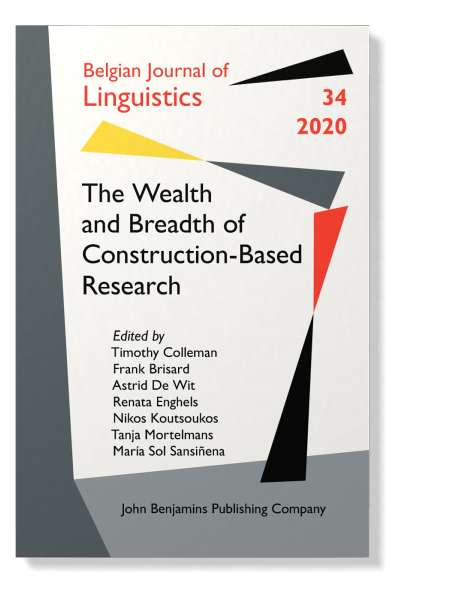
Article published In: The Wealth and Breadth of Construction-Based Research:
Edited by Timothy Colleman, Frank Brisard, Astrid De Wit, Renata Enghels, Nikos Koutsoukos, Tanja Mortelmans and María Sol Sansiñena
[Belgian Journal of Linguistics 34] 2020
► pp. 295–305
Strong resultative constructions in Romance between usage and norm
Evidence from Northern Calabria
Published online: 28 May 2021
https://doi.org/10.1075/bjl.00054.rom
https://doi.org/10.1075/bjl.00054.rom
Abstract
The presence of strong resultative constructions in Romance languages is largely debated. In this paper, we
provide evidence of strong resultative constructions with adjectival predicate in Italo-Romance. Data from Southern Italian
varieties spoken in the area of Cosenza, in Northern Calabria, are discussed. The usage and distribution of two types of
adjectival resultative are accounted for in relation to both structural and functional properties, and sociolinguistic
variables.
Article outline
- 1.The construction portare finito in Northern Calabria
- 2.
Portare finito and the resultative constructions in Italo-Romance
- 2.1Adjectival resultatives in Romance
- 2.2The curious case of a strong resultative construction in Cosentian
- 3.Usage and distribution of portare finito: An investigation into the varieties of Cosenza, Rende and
Rogliano
- 3.1Object animacy and sociolinguistic variables
- 3.2 Portare finito between semantic changes and ‘creative’ uses
- Notes
References

References (38)
Bates, Elisabeth, Cristina Burani, Simona D’Amico, and Laura Barca. 2001. “Word Reading and Picture Naming in Italian.” Memory & Cognition 29 (7): 986–999.
Beavers, John. 2010. “The Structure of Lexical Meaning: Why Semantics Really Matters.” Language 86 (4): 821–864.
Beavers, John, Beth Levin, and Shiao Wei Tham. 2010. “The Typology of Motion Expressions Revisited.” Journal of Linguistics 46 (2): 331–377.
Benincà, Paola, and Cecilia Poletto. 2005. “Phrasal Verbs in Venetan and Regional Italian.” In Language Variation – European Perspectives. Selected papers from the Third International Conference on Language Variation
in Europe (ICLaVE 3), ed. by Frans L. Hinskens, 9–22. Amsterdam/Philadelphia: John Benjamins.
Bertinetto, Pier M. 1986. Tempo, aspetto e azione nel verbo italiano [Tense, aspect and actionality in the Italian verb]. Firenze: Accademia della Crusca.
Bertinetto, Pier M., and Denis Delfitto. 2000. “Aspect vs. Actionality: Some Reasons for Keeping Them Apart.” In Tense and Aspect in the Languages of Europe, ed. by Östen Dahl, 189–225. Berlin: Mouton – De Gruyter.
Boas, Hans. 2003. A Constructional Approach to Resultatives. Stanford: Center for the Study of Language and Information Publications.
Broccias, Cristiano. 2003. The English Change Network. Forcing Changes into Schemas. Berlin: Mouton – De Gruyter.
. 2004. “The Cognitive Basis of Adjectival and Adverbial Resultative Constructions.” Annual Review of Cognitive Linguistics 2 (1): 103–126.
Croft, William, Barðdal Jóhanna, Willem Hollmann, Violeta Sotirova, and Chiaki Taoka. 2010. “Revising Talmy’s Typological Classification of Complex Event Constructions.” In Contrastive Studies in Construction Grammar, ed. by Hans Boas: 201–236. Amsterdam/Philadelphia: John Benjamins.
Folli, Raffaella. 2001. “Two Strategies to Construct Telicity: a Comparative Analysis of English and Italian.” Oxford University Working Papers in Linguistics, Philology and Phonetics 61: 47–66.
Folli, Raffaella, and Gillian Rachmand. 2005. “Prepositions and Results in Italian and English: an Analysis from Event Decomposition.” In Perspectives on Aspect, ed. by Henk Verkuyl, Angeliek van Hout, and Henriëtte de Swart, 81–105. Dordrecht: Springer.
Folli, Raffaella, and Heidi Harley. 2004. “Consuming Results in Italian & English: Flavours of V.” In Aspectual Inquiries, ed. by Roumyana Slabakova, and Paula Kempchinsky, 95–120. Dordrecht: Kluwer.
Iacobini, Claudio. 2012. “Grammaticalization and Innovation in the Encoding of Motion Events.” Folia Linguistica 46 (2): 359–385.
Iacobini, Claudio, and Francesca Masini. 2009. “I verbi sintagmatici dell’italiano tra innovazione e persistenza: il ruolo dei dialetti Phrasal verbs in Italian
between innovation and persistence: The role of dialects].” In Italiano, italiani regionali e dialetti, ed. by Paola Benincà, Paolo Chinellato, Patrizia Cordin, Verner Egerland, Claudio Iacobini, Francesca Masini, Nicoletta Penello, Cecilia Poletto, and Anna Vera Sullam, 115–135. Milano: Franco Angeli.
Krifka, Manfred. 1998. “The Origins of Telicity.” In Events and Grammar, ed. by Susan Rothstein, 197–235. Dordrecht: Springer.
Levin, Beth, and Malka Rappaport Hovav. 1995. Unaccusativity. at the Syntax-Lexical Semantics Interface. Cambridge/London: The MIT Press.
Mateu, Jaume. 2000. “Why Can’t We Wipe the Slate Clean? A Lexical-Syntactic Approach to Resultative Constructions.” Catalan Working Papers in Linguistics 81: 71–95.
Métairy, Justine, Peter Lauwers, Renata Enghels, Miriam Taverniers, and Marleen Van Peteghem. 2020. “A Micro-Typological Perspective on Resultative Secondary Predicates: the Case of Nomination Verb
Constructions.” Language Sciences, 781: 1–18.
Morita, Chigusa. 2009. “A Crosslinguistic Observation of Resultative Constructions.” Linguistic Research 251: 43–55.
Napoli, Donna J. 1992. “Secondary Resultative Predicates in Italian.” Journal of Linguistics 28 (1): 53–90.
Riccio, Anna. 2018. “The Syntax-Semantic Interface in Italian Result-Oriented Argument Structures.” In Applying and Expanding Role and Reference Grammar, ed. by Rolf Kailuweit, Lisann Künkel, and Eva Staudinger, 175–188. Freiburg: FRIAS.
Romagno, Domenica. 2015. “Telicità inerente e telicità configurazionale: l’uso del clitico dativo in alcune varietà dialettali
della Calabria settentrionale [Inherent and compositional telicity: The use of the dative clitic pronoun in some dialectal varieties
of Northern Calabria].” L’Italia Dialettale 761: 163–179.
. 2020. “Ancora sull’uso del clitico dativo in alcune varietà dialettali della provincia di Cosenza. Fra
semantica di interfaccia e gerarchia di possesso [Further investigations into the use of the dative clitic pronoun in some dialectal varieties of the
area of Cosenza: Between interface semantics and possession].” Lingua e Stile 551: 125–152.
Simone, Raffaele. 2008. “Coefficienti verbali nei nomi [Verbal coefficients in nouns].” In Categorie del verbo diacronia, teoria, tipologia. Atti del XXXI Convegno della Società Italiana di Glottologia (Pisa,
26–28 ottobre 2006), ed. by Pier M. Bertinetto, Valentina Bambini, Cristina Bertoncin, and Margherita Farina, 83–113. Roma: il Calamo.
Simpson, Jane. 1983. “Resultatives.” In Papers in Lexical-Functional Grammar, ed. by Beth Levin, Malka Rappaport Hovav, and Annie Zaenen, 143–157. Bloomington: Indiana University Linguistics Club.
Talmy, Leonard. 1975. “Semantics and Syntax of Motion.” In Syntax and Semantics 4, ed. by John P. Kimball, 181–238. New York: Academic Press.
. 1985. “Lexicalization Patterns: Semantic Structure in Lexical Forms.” In Language Typology and Syntactic Description. Volume 3, ed. by Timothy Shopen, 57–149. New York: Cambridge University Press.
. 1991. “Path to Realization – via Aspect and Result.” In Proceedings of the Seventeenth Annual Meeting of the Berkeley Linguistics Society, ed. by Laurel Sutton, Christopher Johnson, and Ruth Shields, 480–519. Berkeley: Berkeley Linguistics Society.
Traugott, Elizabeth Closs, and Graeme Trousdale. 2010. “Gradience, Gradualness and Grammaticalization: How Do They Intersect?” In Gradience, Gradualness and Grammaticalization, ed. by Elizabeth Closs Traugott, and Graeme Trousdale, 19–44. Amsterdam/Philadelphia: John Benjamins.
Van Valin, Robert D. 2005. Exploring the Syntax-Semantics Interface. Cambridge: Cambridge University Press.
Cited by (2)
Cited by two other publications
Métairy, Justine
This list is based on CrossRef data as of 3 december 2025. Please note that it may not be complete. Sources presented here have been supplied by the respective publishers. Any errors therein should be reported to them.