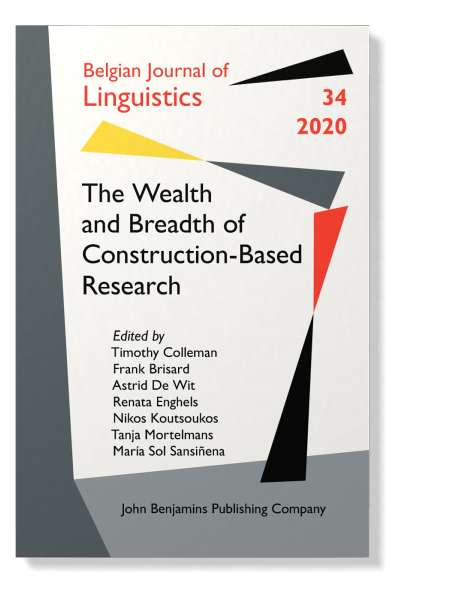
Article published In: The Wealth and Breadth of Construction-Based Research:
Edited by Timothy Colleman, Frank Brisard, Astrid De Wit, Renata Enghels, Nikos Koutsoukos, Tanja Mortelmans and María Sol Sansiñena
[Belgian Journal of Linguistics 34] 2020
► pp. 213–224
Pragmatic information in constructions
What do speakers generalize?
Published online: 28 May 2021
https://doi.org/10.1075/bjl.00047.kuz
https://doi.org/10.1075/bjl.00047.kuz
Abstract
Despite recent advances in Construction Pragmatics, a systematic way for delimiting coded pragmatic information has yet to
be offered. This squib provides a step in establishing such an account by assessing what kind of pragmatic information speakers generalize
from various usage-events. Drawing on findings from Conversation Analysis, I propose a distinction between pragmatic functions as speakers’
actions, and interactional patterns as discourse-information sequences. A synchronic examination of the Hebrew multifunctional discourse
marker ′at/a yode′a/′at (′know.prs.m/f.sg′) demonstrates the consistent use of the
construction in an interactional pattern across numerous usage-events. A qualitative diachronic analysis of ′at/a
yode′a/′at suggests that speakers may associate forms with interactional patterns rather than with functions.
This preliminary evidence provides support for the generalization of interactional patterns.
Article outline
- 1.Introduction
- 2.Functions vs. interactional patterns
- 3.The generalization of interactional patterns
- 4.Concluding remarks
- Acknowledgements
- Notes
References

References (21)
Bybee, Joan. 2013. “Usage-based Theory and Exemplar Representations of Constructions.” In The Oxford Handbook of Construction Grammar, ed. by Thomas Hoffmann, and Graeme Trousdale, 49–69. Oxford: Oxford University Press.
Cappelle, Bert. 2017. “What’s Pragmatics Doing outside Constructions?” In Semantics and Pragmatics: Drawing a Line, ed. by Ilse Depraetere, and Raphael Salkie, 115–151. Cham: Springer.
Enghels, Renata. 2018. “On the Grammaticalization of the Deverbal Epistemic Pragmatic Marker sabes. A Study in Recent
Language Change.” Romanian Review of Linguistics 63 (4): 341–360.
Fillmore, Charles J. 1987. “A Private History of the Concept ‘Frame’.” In Concepts of Case, ed. by René Dirven, and Giinter Radden, 28–36. Tiibingen: Narr.
Finkbeiner, Rita. 2019. “Introduction: Reflections on the Role of Pragmatics in Construction Grammar.” Constructions and Frames 11 (2): 171–192.
Fischer, Kerstin. 2015a. “Conversation, Construction Grammar, and Cognition.” Language and Cognition 7 (4): 563–588.
. 2015b. “Situation in Grammar or in Frames? Evidence from the So-called Baby Talk Register.” Constructions and Frames 7 (2): 258–288.
Fox Tree, Jean E., and Josef C. Schrock. 2002. “Basic Meanings of you know and I mean.” Journal of Pragmatics 34 (6): 727–747.
Fried, Mirjam, and Jan-Ola Östman. 2005. “Construction Grammar and Spoken Language: The Case of Pragmatic Particles.” Journal of Pragmatics 37 (11): 1752–1778.
Hary, Benjamin, and Shlomo Izre’el. 2003. “The Preparatory Model of the Corpus of Spoken Israeli Hebrew (CoSIH).” In Corpus Linguistics and Modern Hebrew: Towards the Compilation of the Corpus of Spoken Israeli Hebrew (CoSIH), ed. by Benjamin Hary, 189–219. Tel Aviv: Tel Aviv University Press.
Heine, Bernd. 2013. “On Discourse Markers: Grammaticalization, Pragmaticalization, or Something Else?” Linguistics 51 (6): 1205–1247.
Hoffmann, Thomas. 2017. “Multimodal Constructs – Multimodal Constructions? The Role of Constructions in the Working Memory.” Linguistics Vanguard 3 (s1).
Maschler, Yael. 2009. Metalanguage in Interaction: Hebrew Discourse Markers. Amsterdam/Philadelphia: John Benjamins.
. 2012. “Emergent Projecting Constructions: The Case of Hebrew yada (‘know’).” Studies in Language 36 (4): 785–847.
Melnik, Nurit. 2006. “A Constructional Approach to Verb-initial Constructions in Modern Hebrew.” Cognitive Linguistics 17 (2): 153–198.
Cited by (3)
Cited by three other publications
Foolen, Ad
This list is based on CrossRef data as of 3 december 2025. Please note that it may not be complete. Sources presented here have been supplied by the respective publishers. Any errors therein should be reported to them.