Article published In: Variation in the Pacific: Part II
Edited by Eri Kashima and Miriam Meyerhoff
[Asia-Pacific Language Variation 7:1] 2021
► pp. 30–61
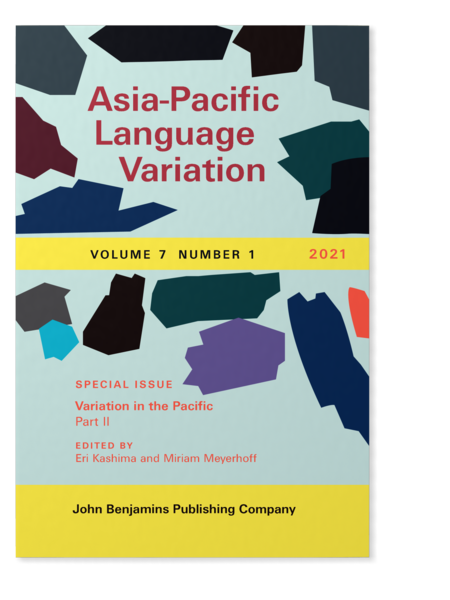
Ende oration and final /n/-realisation
Published online: 9 June 2021
https://doi.org/10.1075/aplv.19013.lin
https://doi.org/10.1075/aplv.19013.lin
Abstract
This paper presents a sociophonetic analysis of word-final /n/-elision in Ende (Pahoturi River; Papuan). An analysis of 73 speakers reveals that tense, phonological context, and most significantly, whether or not the speaker is a kawa practitioner, a prestigious type of public oration, are significantly correlated with /n/-retention. A closer look at just five kawa practitioners reveals that age and genre may also play a role. The present study matches Schokkin’s analysis of /n/-elision in Idi (this issue). Indeed, the findings support her conclusions that this pattern is one of /n/-elision (not /n/-addition) and show similarities in conditioning factors. Analysing sociolinguistic variation in this region presents a unique set of benefits and challenges. This paper discusses how emically-derived categories relating to age, clan, and orator status may deviate from characterisations of prestige in Westernised and urbanised societies but better fit southern New Guinea’s social context.
Keywords: age, elision, genre, oration, Pahoturi River, Papua New Guinea, Papuan, prestige, sociophonetic variation
Abstract (Indonesian)
Penelitian ini menunjukan penemuan analisis sosiofonetik dari kata-akhir /n/-peniadaan bunyi dalam ucapan di Bahasa Ende (Sungai Pahoturi; Papua). Analisis dari 73 pembicara mengungkapkan bahwa kata yang mewakili waktu, konteks fonologis, dan yang paling penting apakah sang pembicara adalah seorang pembicara kawakan, jenis orasi publik yang bergengsi, yang berkorelasi signifikan dengan penyimpanan-/n/. Penelitian kepada lima praktisi kawa membuktikan bahwa umur dan aliran juga mungkin bisa mempengaruhi ini. Penelitian ini dirancang untuk membandingkan kata-akhir /n/-peniadaan bunyi dalam ucapan yang terkait ldi dari analisis Schokkin (permasalahan ini). Memang, penemuan ini telah mendukung kesimpulan bahwa salah satu pola dari /n/-peniadaan bunyi dalam ucapan (sebagai lawan kepada /n/-tambahan) memperlihatkan banyak kesamaan dalam faktor pengkondisian. Menganalisis variasi sosiolinguistik yang baru di daerah ini mempersembahkan beberapa manfaat dan tantangan. Penelitian ini membahas bagaimana kategori yang terkait dengan umur, suku, dan status orator yang diturunkan secara teknis bisa menyimpang dari karakterisasi prestise di masyarakat yang kebaratan-baratan dan urban tetapi lebih cocok ke konteks sosial New Guinea.
Article outline
- 1.Introduction
- 1.1The Ende language community
- 1.2Variable /n/-realisation
- 1.3Kawa oration
- 2.Data collection and token selection
- 2.1Token selection
- 3.Results
- 3.1Coding and factor selection
- 3.2Linguistic factors
- 3.3Social factors
- 3.4Statistical modelling and results
- 4.Discussion
- 5.Conclusion
- Acknowledgements
- Notes
- Glossing abbreviations used within this article are the following
References

References (44)
Barth, Danielle, Schokkin, Dineke, Travis, Catherine, Lindsey, Kate L., & Stanford, James N. (2019). Variation off the beaten track: expanding our understanding of social structures. Workshop presented at New Ways of Analyzing Variation, Eugene, OR.
Bates, Douglas, Mächler, Martin, Bolker, Ben, & Walker, Steve (2015). Fitting linear mixed-effects models using lme4. Journal of Statistical Software, 67(1), 1–48.
Brickhouse, Christian, & Lindsey, Kate L. (2020). Investigating the phonetics-phonology interface with field data: Assessing phonological specification through acoustic trajectories. Poster presented at the Annual Meeting of the Linguistic Society of America, New Orleans, LA.
Browman, Catherine P., & Goldstein, Louis (1992). Articulatory phonology: An overview. Phonetica, 49(3–4), 155–180.
Clarke, Sandra (2009). Sociolinguistic stratification and new dialect formation in a Canadian aboriginal community: Not so different after all? In James N. Stanford & Dennis R. Preston (Eds.), Variation in indigenous minority languages (pp. 109–128). John Benjamins.
Dareda, Jerry (Jeks) (2016). Ende tän bo eka [The Ende Tribe]. In The language corpus of Ende and other Pahoturi River languages. Pacific and Regional Archive for Digital Sources in Endangered Cultures. Retrieved February 22, 2021,, from [URL]
Döhler, Christian (2018). A grammar of Komnzo. In Studies in Diversity Linguistics, 201. Language Science Press.
Eberhard, David M., Simons, Gary F., & Fennig, Charles D. (Eds.) (2019). Ethnologue: Languages of the world (22nd ed.). SIL International. Retrieved February 22, 2021, from [URL]
Eckert, Penelope (1989). The whole woman: Sex and gender differences in variation. Language Variation and Change, 1(3), 245–267.
(2017). Age as a sociolinguistic variable. In Florian Coulmas (Ed.), The handbook of sociolinguistics (pp. 151–167). Blackwell.
Evans, Nicholas (n.d.). Languages of Southern New Guinea Project (LSNG02). Digital collection managed by PARADISEC. [Open Access].
(2012). Even more diverse than we had thought: The multiplicity of trans-Fly languages. In Nicholas Evans & Marian Klamer (Eds.), Melanesian languages on the edge of Asia: Challenges for the 21st century. Language Documentation and Conservation, Special Publication No. 5 (pp. 109–149).
Evans, Nicholas, Arka, Wayan, Carroll, Matthew, Choi, Yun Jung, Döhler, Christian, Gast, Volker, Kashima, Eri, Mittag, Emil, Olsson, Bruno, Quinn, Kyla, Schokkin, Dineke, Tama, Philip, van Tongeren, Charlotte, & Siegel, Jeff (2018). The languages of Southern New Guinea. In Bill Palmer (Ed.), The languages and linguistics of New Guinea: A comprehensive guide. De Gruyter Mouton.
Geoff, Quinten (2018). Sociolinguistic questionnaire – Quinten Geoff. In The language corpus of Ende and other Pahoturi River languages. Pacific and Regional Archive for Digital Sources in Endangered Cultures. Retrieved on February 22, 2021, from [URL]
Joanang, Kalamato (2018). Sociolinguistic questionnaire – Kalamato Joanang. In The language corpus of Ende and other Pahoturi River languages. Pacific and Regional Archive for Digital Sources in Endangered Cultures. Retrieved on February 22, 2021 from [URL]
Kashima, Eri (2020). Language in my mouth: Linguistic variation in the Nmbo speech community of Southern New Guinea. Doctoral dissertation, The Australian National University. Retreived on February 22, 2021, from
King, Sharese (2018). Exploring social and linguistic diversity across African Americans from Rochester, New York. Doctoral dissertation, Stanford University. Retrieved on February 22, 2021, from [URL]
Kurupel (Suwede), Warama (2018). Sociolinguistic questionnaire – Warama Kurupel. In The language corpus of Ende and other Pahoturi River languages. Pacific and Regional Archive for Digital Sources in Endangered Cultures. Retrieved on February 22, 2021, from [URL]
Kurupel, Sowati (2018). Sociolinguistic Questionnaire – Sowati Kurupel. In The language corpus of Ende and other Pahoturi River languages. Pacific and Regional Archive for Digital Sources in Endangered Cultures. Retreived on February 22, 2021, from [URL]
Labov, William (1990). The intersection of sex and social class in the course of linguistic change. Language Variation and Change, 2(2), 205–254.
Lindsey, Kate L. (2015). Language corpus of Ende and other Pahoturi River languages. The Pacific And Regional Archive for Digital Sources in Endangered Cultures (PARADISEC).
(2019). Ghost elements in Ende phonology. Doctoral dissertation, Stanford University. Retreived on February 22, 2021, from [URL]
Lindsey, Kate L., & Brickhouse, Christian (2020). Laboratory phonology without the lab: evaluating articulatory specification change in a Papuan language. Poster presented at LabPhon17, Vancouver, BC.
Mansfield, John, & Stanford, James N. (2017). Documenting sociolinguistic variation in lesser studied indigenous communities: Challenges and practical solutions. In Kristine A. Hildebrandt, Carmen Jany, & Wilson Silva (Eds.), Documenting variation in endangered languages. Language Documentation and Conservation Special Publication, 131, 116–136. Honolulu: University of Hawai–i Press. [URL]
Munsiff, Leela, & Lindsey, Kate L. (2020). Sociolinguistic study of Limol village reveals interclan marriages and code-switching. Paper submitted to the Undergraduate Research Opportunity Program (UROP) Annual Conference.
Scanlon, Catherine (2018). Ende recordings (CS3). Digital collection managed by PARADISEC. [Open Access].
Schokkin, Dineke (2014). Recordings of the Idi language (WSDS1). Digital collection managed by PARADISEC. [Open Access].
(2018). Estoterogeny and the “expert mumble”: Final /n/ elision in Idi. Linguistic Seminar, University of Cologne. [URL]
Schokkin, Dineke, Gast, Volker, Evans, Nicholas, & Döhler, Christian (2021). Idi phonetics and phonology. In Kate L. Lindsey & Dineke Schokkin (Eds.), Phonetic fieldwork in southern New Guinea. Language Documentation and Conservation Special Publication, 241, 76–107. Honolulu: University of Hawai’i Press. [URL]
Skilton, Amalia (2017). Three speakers, four dialects: Documenting variation in an endangered Amazonian language. In Kristine A. Hildebrandt, Carmen Jany, & Wilson Silva (Eds.), Documenting variation in endangered languages. Language Documentation and Conservation Special Publication, 131, 94–115. Honolulu: University of Hawai’i Press. [URL]
Smakman, Dick, & Heinrich, Patrick (Eds.) (2015). Globalising sociolinguistics: Challenging and expanding theory. New York: Routledge.
Stanford, James N. (2009). Clan as a sociolinguistic variable: Three approaches to Sui clans. In J. N. Stanford & Dennis R. Preston (Eds.), Variation in indigenous minority languages (pp. 463–484). Philadelphia: John Benjamins.
Strong, Katherine Anne, Lindsey, Kate L., & Drager, Katie (2020). Gender, oration, and variable affrication in Ende. University of Pennsylvania Working Papers in Linguistics, 26(2).
Suokhrie, Kelhouvinuo (2016). Clans and clanlectal contact: Variation and change in Angami. Asia-Pacific Language Variation, 2(2), 188–214.
Wagner, S. Evans (2012). Age grading in sociolinguistic theory. Language and Linguistics Compass, 6(6), 371–382.
Wassink, A. Beckford (2015). Sociolinguistic patterns in Seattle English. Language Variation and Change, 27(1), 31–58.
Wedel, Andrew, Kaplan, Abby, & Jackson, Scott (2013). High functional load inhibits phonological contrast loss: A corpus study. Cognition, 128(2), 179–186.
Wickham, Hadley (2016). ggplot2: Elegant Graphics for Data Analysis [computer software]. Springer-Verlag New York. Retrieved on February 22, 2021, from [URL].
Williams, F. E. (1932). Sex affiliation and its implications. The Journal of the Royal Anthropological Institute of Great Britain and Ireland, 621, 51–81. Available from [URL].
Cited by (4)
Cited by four other publications
Mansfield, John
Lindsey, Kate L., Dineke Schokkin & Nairan Wu
Satyanath, Shobha
2022. Standard-ness, national ideologies and their embedding in ‘sociolinguistic theory’. Asia-Pacific Language Variation 8:2 ► pp. 174 ff.
Strong, Katherine, Kate L. Lindsey & Katie Drager
2022. Kawa and the variable stopping of obstruents in Ende. Asia-Pacific Language Variation 8:2 ► pp. 150 ff.
This list is based on CrossRef data as of 1 december 2025. Please note that it may not be complete. Sources presented here have been supplied by the respective publishers. Any errors therein should be reported to them.