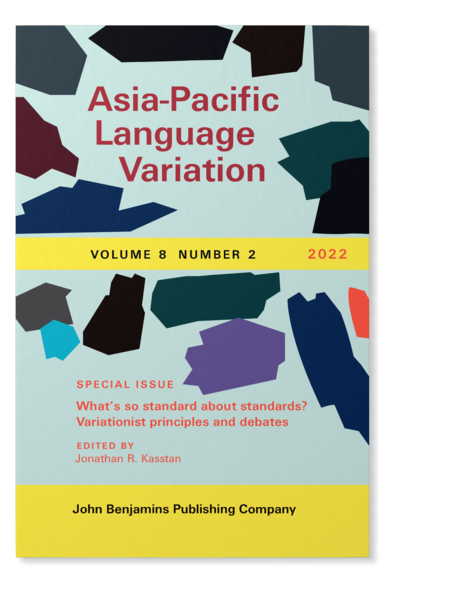
Introduction published In: What’s so standard about standards? Variationist principles and debates
Edited by Jonathan R. Kasstan
[Asia-Pacific Language Variation 8:2] 2022
► pp. 139–149
Introduction
What’s so standard about standards?
Published online: 1 December 2022
https://doi.org/10.1075/aplv.00016.int
https://doi.org/10.1075/aplv.00016.int

References (38)
Adli, Aria, & Guy, Gregory (2022). Globalising the study of language variation and change: A manifesto on cross-cultural sociolinguistics. Language and Linguistics Compass 16(5). e12452.
Bell, Allan (2017). Giving voice: A personal essay on the shape of sociolinguistics. Journal of Sociolinguistics, 21(5), 587–602.
Bourdieu, Pierre (1977). The economics of linguistic exchange. Social Science Information 161, 645–668.
Bromham, Lindell, Dinnage, Russel, Skirgård, Hedvig, Ritchie, Andrew, Cardillo, Marcel, Meakins, Felicity, Greenhill, Simon, & Xia Hua (2021). Global predictors of language endangerment and the future of linguistic diversity. Nature: Ecology & Evolution, 61, 163–173.
Campbell, Lyle, Lee, Nala Huiying, Okura, Eve, Simpson, Sean, Ueki, Kaori, & Van Way, John (2013). New knowledge: findings from the Catalogue of Endangered Languages (ELCat). Paper presented at the 3rd International Conference on Language Documentation and Conservation, Honolulu, Hawai‘i, Feb. 28.
Cheshire, Jenny (2005). Syntactic variation and spoken language. In: L. Cornips & K. Corrigan (Eds.), Syntax and variation: Reconciling the biological and the social. Amsterdam: John Benjamins, 81–106.
Coupland, Nikolas (2016). Five Ms for sociolinguistic change. In Nikolas Coupland (Eds.), Sociolinguistics: Theoretical debates. Cambridge: Cambridge University Press, 433–455.
Dorian, Nancy C. (1981). Language death: The life cycle of a Scottish Gaelic dialect. Pennsylvania: University of Pennsylvania Press.
(1994a). Varieties and variation in a very small place: Social homogeneity, prestige norms, and linguistic variation. Language, 70(4), 631–698.
(1994b). Purism vs. compromise in language revitalization and language revival. Language in Society, 23(4), 479–494.
(2010). Investigating variation: The effects of social organization and social setting. Oxford: Oxford University Press.
Eckert, Penelope. (2012). Three waves of variation study: The emergence of meaning in the study of sociolinguistic variation. Annu. Rev. Anthropol, 411, 87–100.
Eckert, Penelope, & Rickford, John R. (Ed.) (2001). Style and sociolinguistic variation. Cambridge: Cambridge University Press.
Hildebrandt, Kristine A., Carmen, Jany, & Wilson, Silva (Eds.) (2017). Documenting variation in endangered languages. Language Documentation & Conservation Special Publication, 131, 1–5.
Hill, Jane. H. & Hill, Kenneth (1986). Variable developments of -āškā ‘possession’ in Modern Mexicano (Nahualt). International Journal of American Linguistics, 521, 404–410.
Kroskrity, Paul V. (2010). Language Ideologies--Evolving Perspectives. In Jürgen Jaspers, Jan-Ola. Östman, & Jeff Verschueren (Eds.), Society and language use. Amsterdam: John Benjamins, 192–211.
Labov, William ([1966] 2006). The social stratification of English in New York City (2nd edition). Cambridge: Cambridge University Press.
Lee, Nala H. (2020). The status of endangered contact languages of the world. Annu. Rec. Linguist. 61, 301–318.
Lippi-Green, Rosina (1994). Accent, standard language ideology, and discriminatory pretext in courts. Language in Society, 23(2), 163–198.
Loh, Jonathan & Harmon, David (2014). Biocultural diversity: Threatened species, endangered languages. Zeist: WWF Netherlands.
Lüpke, Friederike (2021). Standardization in highly multilingual national contexts. In: Wendy Ayres-Bennett & John Bellamy (Eds.), The Cambridge handbook of language standardization. Cambridge: Cambridge University Press, 139–169.
Milroy, James (2001). Language ideologies and the consequences of standardization. Journal of Sociolinguistics, 5(4), 530–555.
Nagy, Naogy, & Meyerhoff, Miriam (2008). The social lives of linguistics. In M. Meyerhoff & N. Nagy (Eds.), Social lives in language – Sociolinguistics and multilingual speech communities (pp. 1–7). Amsterdam: John Benjamins.
(2019). The role of standards in the field of variation. Paper presented at New Ways of Analyzing Variation (NWAV) 48, University of Oregon.
Rickford, John R. (1986). The need for new approaches to social class analysis in Sociolinguistics. Language & Communication, 6(3): 215–221.
Sankoff, Gillian (1980[1976]). The social life of language. Philadelphia: The University of Pennsylvania Press.
Satyanath, Shobha (1990). The use of pronouns and its implications for the implicational model of decreolozation in Guyanese. The Penn Review of Linguistics, 141, 129–142.
(2015). Language variation and change: The Indian experience. In: Dick Smakman, & Patrick Heinrich (Eds.), Globalising Sociolinguistics: Challenging and expanding theory (pp.107–122.). London: Routledge.
Schieffelin, Bambi, Woolard, Kathryn & Kroskrity, Paul V. (Eds.) (1998). Language ideologies, theory and practice. New York: Oxford University Press.
Sharma, Devyani (2017). World Englishes and sociolinguistic theory. In M. Filppula, J. Klemola, & D. Sharma (Eds.), The Oxford handbook of World Englishes (pp. 232–251). Oxford: Oxford University Press.
Silverstein, M. (1992). The uses and utility of ideology: some reflections. Pragmatis, 2(3), 311–323.
Stanford, James N. (2009). Clan as a sociolinguistic variable: Three approaches to Sui clans. In: J. N. Stanford & D. R. Preston (Eds.), Variation in indigenous minority languages. Amsterdam: John Benjamins, 463–484.
(2016). A call for more diverse sources of data: Variationist approaches in non-English contexts. Journal of Sociolinguistics, 20(4),525–541.
Stanford, James N., & Preston, Dennis (2009). The lure of a distant horizon: Variation in indigenous minority languages. In: James N. Stanford & Dennis Preston (Eds.), Variation in Indigenous Minority Languages (pp. 1–22). Amsterdam: John Benjamins.
Cited by (2)
Cited by two other publications
This list is based on CrossRef data as of 1 december 2025. Please note that it may not be complete. Sources presented here have been supplied by the respective publishers. Any errors therein should be reported to them.