Article published In: Classifiers
Edited by Alexandra Y. Aikhenvald
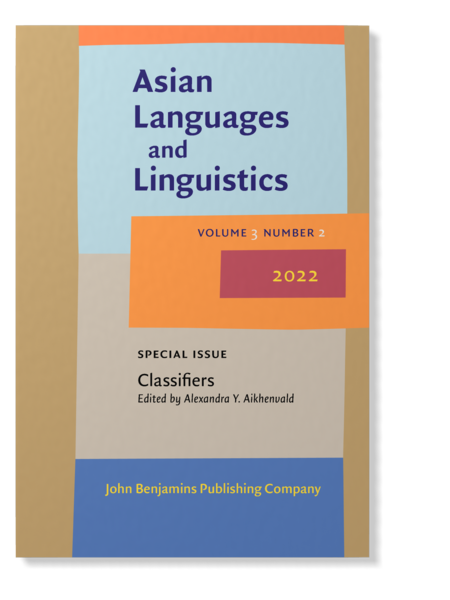
[Asian Languages and Linguistics 3:2] 2022
► pp. 141–152
Classifiers: Setting the scene
An introduction to the special issue on classifiers in the languages of Asia
Published online: 26 January 2023
https://doi.org/10.1075/alal.22022.aik
https://doi.org/10.1075/alal.22022.aik
Abstract
Classifiers are morphemes which occur under specifiable conditions and which categorise nominal referents in terms
of their animacy, shape, and other properties. The most widely represented type is numeral classifiers, which occur next to a
number word or a quantifier. Further types include noun classifiers, verbal classifiers, classifiers in possessive constructions,
and deictic classifiers. One language can have more than one type of classifier. In some, the same set of classifiers occurs in
several classifier contexts, corroborating the unity of the phenomenon. Classifiers categorise nouns, and have to be distinguished
from verbal action markers used to categorise and count actions. Classifiers have a variety of functions, and are never
semantically redundant. Classifiers mirror social attitudes and hierarchies, physical environment and means of subsistence, and
are susceptible to change in language contact situations. Contributions to this issue adress the systems and the functions of
numeral classifiers and also classifiers in multiple contexts across Asia and beyond, including Austronesian languages of Taiwan,
a selection of Tibeto-Burman (or Trans-Himalayan) languages, Zhuang, a Tai-Kadai language, and Kazakh, a Turkic language.
Article outline
- 1.Classifiers: An overview
- 2.The utility of classifiers
- 3.About this special issue
- Acknowledgements
- Notes
- Abbreviations
References

References (32)
Aikhenvald, Alexandra Y. 2000. Classifiers: a typology of noun
categorization devices. Oxford: Oxford University Press.
2015. Oxford Bibliography Online:
Classifiers (refereed updateable resource with summaries and evaluation for each
entry). General Editor: Mark Aronoff. New York: Oxford University Press (online).
2019. ‘Noun categorization devices: a
cross-linguistic perspective’, in A. Y. Aikhenvald and Elena Mihas (eds.), Genders
and classifiers: a cross-linguistic
study. Oxford: Oxford University Press, pp. 1–29.
Aikhenvald, Alexandra Y. Forthcoming. A guide to gender and classifiers. Oxford: Oxford University Press.
Bai, Junwei. 2019. ‘Numeral
classifiers in Munya, a Tibeto-Burman
language’, pp. 282–98 of Genders
and classifiers: a cross-linguistic study, edited by Alexandra Y. Aikhenvald and Elena Mihas. Oxford: Oxford University Press.
. 2020. ‘A
grammar of Munya’. PhD thesis, James Cook University.
Becker, Anton J. 1975. ‘A linguistic image of nature:
the Burmese numerative classifier
system’. Linguistics 1651: 109–121.
Beckwith, Christopher I. 1998. ‘Noun Specification and
Classification in Uzbek’, Anthropological
Linguistics 401: 124–140.
Bisang, Walter. 2017. ‘Classification
between Grammar and Culture. A Cross-Linguistic
Perspective’, pp. 199–230 of Classification
from Antiquity to Modern Times, edited by Tanja Pommerrening and Walter Bisang. Berlin: De Gruyter.
Braun, Friederike. 2000. Geschlecht
im Türkischen. Untersuchungen zum sprachlichen Umgang mit einer sozialen
Kategorie. Wiesbaden: Harrassowitz Verlag.
Chao, Yuen-Ren. 1968. A
grammar of spoken Chinese. Berkeley and Los Angeles: University of California Press.
Day, C. 1973. The
Jacaltec language. Indiana University Publications. Language
Science monographs 12.
Downing, Pamela. 1996. Numeral
Classifier Systems: The Case of
Japanese. Amsterdam: John Benjamins.
Enfield, N. J. 2021. The
langages of Mainland Southeast
Asia. Cambridge: Cambridge University Press.
Gerner, Matthias. 2015. ‘Verb
classifiers in East Asia’, Functions of
Language 211: 267–296.
Givón, T. 1981. ‘On
the development of numeral ‘one’ as an indefinite marker’, Folia Linguistica
Historica 21: 35–53.
Heine, Bernd and Kuteva, Tania. 2002. The
world lexicon of
grammaticalization. Cambridge: Cambridge University Press.
Jarkey, Nerida and Hiroko Komatsu. 2019. Numeral
classifiers in Japanese. In Alexandra Y. Aikhenvald and Elena Mihas (eds.), Genders
And Classifiers: A Cross-Linguistic
Typology, 249–81. Oxford: Oxford University Press.
Kilarski, Marcin. 2013. Nominal
Classification A history of its study from the classical period to the
present. Amsterdam: John Benjamins.
Lu, Tian-Qiao. 2012. Classifiers
in Kam-Tai languages. A cognitive and cultural perspective. Boca Raton: Universal Publishers.
Mahapatra, B. P. 1979. Malto.
An Ethnosemantic Study. Manasagangotro, Mysore: Central Institute of Indian Languages.
Rice, Keren and Willem de Reuse. 2017. ‘The
Athabaskan (Dene) language
family’, pp. 707–747 of The
Cambridge Handbook of Linguistic Typology, edited by Alexandra Y. Aikhenvald and R. M. W. Dixon. Cambridge: Cambridge University Press.
Zavala, Roberto. 2000. ‘Multiple
classifier systems in Akatek
Mayan’, pp. 114–46, Systems
of nominal
classification, edited by G. Senft. Cambridge: Cambridge University Press.
Zubin, D. and M. Shimojo. 1993. ‘How
“general” are general classifiers? with special reference to ko and tsu in
Japanese’, in J. S. Guenter, B. A. Kaiser and C. C. Zoll (eds.) Proceedings
of the Berkeley Linguistics Society: Proceedings of the Annual
Meeting 191: 490–502. Berkeley: Berkeley Linguistics Society.
Cited by (2)
Cited by two other publications
Li, Yu & Mengyang Qiu
Liu, Jia
2024. Cognitive, linguistic, and socio-cultural perspectives on classifier usage. Asian Languages and Linguistics 5:2 ► pp. 310 ff.
This list is based on CrossRef data as of 1 december 2025. Please note that it may not be complete. Sources presented here have been supplied by the respective publishers. Any errors therein should be reported to them.