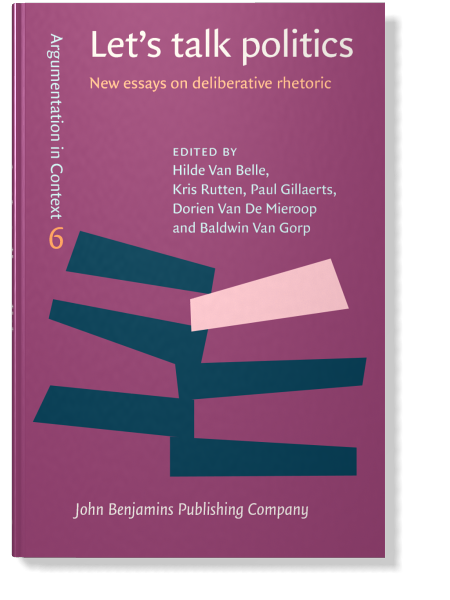
In:Let's talk politics: New essays on deliberative rhetoric
Edited by Hilde Van Belle, Kris Rutten, Paul Gillaerts, Dorien Van De Mieroop and Baldwin Van Gorp
[Argumentation in Context 6] 2014
► pp. 185–204
Learning to differ
Transforming parliament through argument and debate in Poland post-1989
Published online: 30 April 2014
https://doi.org/10.1075/aic.6.11orn
https://doi.org/10.1075/aic.6.11orn
The essay describes how Polish members of parliament (MPs) reinvented the institution of parliament (conceived of in its essentially discursive character as parleyment) in the course of the political transition of 1989. The reinvention of “parliamentary democracy” and deliberation in the chamber involved four interrelated developments: rearticulation of the “people” and thereby providing new basis for parliamentary “representation” and for the rhetorical agency of MPs; redefinition and rearticulation of the relationship between parliament and other organs of state power, especially government; emergence of deliberation through the dialectic between identification and division; and refunctionalization of verbal and non-verbal behaviors to enable exercise of MPs’ rhetorical agency in the plural context. The essay suggests a perspective that sees argumentation and debate as both shaped by and constitutive of “institutions,” a perspective that complements the view of argument and debate in interpersonal terms.

References (32)
Bayley, P. (2004). Introduction. In P. Bayley(Ed.),
Cross-cultural perspectives on parliamentary discourse
(pp. 1–44). Amsterdam: John Benjamins.
Candlin, C. N. (1997). General Editor’s Preface. In B-L. Gunnarsson, P. Linell, & B. Norberg (Eds.),
The construction of professional discourse
(pp. ix-xiv). London: Longman.
Charland, M. (2001). Constitutive rhetoric. In J. O. Sloan (Ed.),
Encyclopedia of rhetoric
(pp. 616–619). New York: Oxford.
Foucault, M. (1972).
The archaeology of knowledge and the discourse on language
. Trans. A. M. Sheridan Smith. New York: Pantheon.
Gunn, J. A. W. (2009).
When the French tried to be British: Party, opposition, and the quest for civil disagreement
, 1814–1848. Montreal: McGill-Queen’s.
Hibbing, J. R., & Patterson, S. C. (1994). The emergence of democratic parliaments in Central and Eastern Europe. In J. R. Hibbing, & S. C. Patterson (Eds.),
Parliaments in the modern world: Changing institutions
(pp. 129–150). Ann Arbor, MI: The University of Michigan Press.
Ihalainen, P., & Palonen, K. (2009). Parliamentary sources in the comparative study of conceptual history: Methodological aspects and illustrations of a research proposal.
Parliaments, Estates, & Representation
, 29, 17–34.
Jackiewicz, I. (1996).
Nowe role w nowym sejmie: Poslowie sejmu okresu transformacji
1989–1993. Warszawa: Wydawnictwo Sejmowe.
Jaworski, A., & Coupland, N. (1999). Introduction: Perspectives on discourse analysis. In A. Jaworski & N. Coupland (Eds.),
The discourse reader
(pp. 1–44)
. London: Routledge.
Kraczkowski, R. (1997). Sejm w okresie PRL. In J. Bardach(Ed.),
Dzieje sejmu polskiego
(pp. 265–306). Warszawa: Wydawnictwo Sejmowe.
McGee, M. C. (1975). In search of ‘the people’: A rhetorical alternative.
The Quarterly Journal of Speech
, 61(3), 235–249.
. (1980). The ‘ideograph’: A link between rhetoric and ideology.
Quarterly Journal of Speech,
66, 1–16.
Olson, D. M., & Norton, P. (1996). Legislatures in democratic transitions. In D. M. Olson & P. Norton (Eds.),
The new parliaments of Central and Eastern Europe
(pp. 1–15). London & Portland, OR: Frank Cass.
Ornatowski, C. M. (2010). Parliamentary discourse and political transition: The case of the Polish parliament after 1989.” In C. Ilie (Ed.),
European parliaments under scrutiny: Discourse strategies and interaction practices
(pp. 223–264). Amsterdam and Philadelphia: John Benjamins.
. (2011). Constructing pluralism: Identification and division in the political transformation of Poland.” In A. de Velasco & M. Lehn (Eds.),
Rhetoric: Concord and controversy
(pp. 41–51). Long Grove, IL: Waveland.
Palonen, K. (2003). Four times of politics: Policy, polity, politicking, and politicization.
Alternatives
28(2), 171–186.
. (2012). Towards a history of parliamentary concepts.
Parliaments, Estates, & Representation
, 32 (2), 123–138.
Patterson, S. C., & Copeland, G. W. (1994). Parliaments in the Twenty-First Century. In G. W. Copeland & S. C. Patterson (Eds.),
Parliaments in the modern world: Changing institutions
(pp. 1–12). Ann Arbor, MI: The University of Michigan Press.
Schmitt, C. (1985).
The crisis of parliamentary democracy
. Trans. E. Kennedy. Cambridge, MA: The MIT Press.
Simon, M. D. (1996). Institutional development of Poland’s post-communist Sejm: A comparative analysis. In D. M. Olson & P. Norton (Eds.),
The new parliaments of Central and Eastern Europe
(pp. 60–81). London and Portland, OR: Frank Cass.
Tindale, C. W. (2004).
Rhetorical argumentation: Principles of theory and practice
. Thousand Oaks, CA: Sage.
van Eemeren, F. H., & R. Grootendorst. (1992).
Argumentation, communication, and fallacies: A pragma-dialectical perspective
. Hillsdale, NJ: Erlbaum.
van Eemeren, F. H., Grootendorst, R., & Francisca Snoeck Henkemans, A. (2002).
Argumentation: Analysis, evaluation, presentation
. Mahvah, NJ: Erlbaum.
Cited by (3)
Cited by three other publications
Dębowska-Kozłowska, Kamila & Dale Hample
Nowak, Bartholomäus
Nowak, Bartholomäus
2019. Impoliteness in parliamentary questions. In Political discourse in Central, Eastern and Balkan Europe [Discourse Approaches to Politics, Society and Culture, 84], ► pp. 147 ff.
This list is based on CrossRef data as of 8 march 2026. Please note that it may not be complete. Sources presented here have been supplied by the respective publishers. Any errors therein should be reported to them.