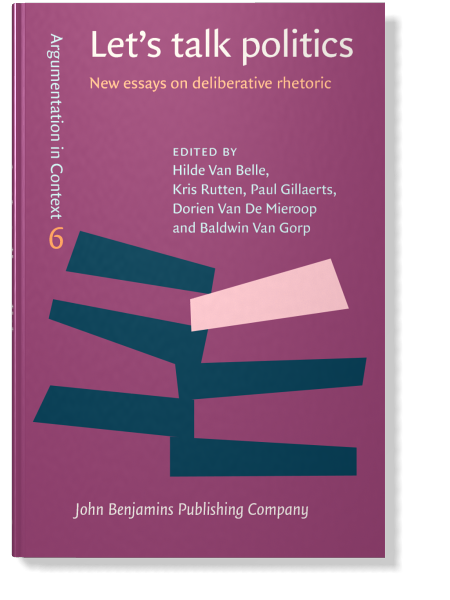
In:Let's talk politics: New essays on deliberative rhetoric
Edited by Hilde Van Belle, Kris Rutten, Paul Gillaerts, Dorien Van De Mieroop and Baldwin Van Gorp
[Argumentation in Context 6] 2014
► pp. 13–25
Aristotle on deliberation
Its place in ethics, politics and rhetoric
Published online: 30 April 2014
https://doi.org/10.1075/aic.6.01koc
https://doi.org/10.1075/aic.6.01koc
Aristotle differs from most later philosophers in distinguishing clearly between epistemic reasoning, which aims for truth, and practical reasoning, which does not. How can he posit this distinction and yet not dismiss practical reasoning as flattery and manipulation, as Plato did? The answer lies in the concepts of deliberation (boulē, bouleusis) and deliberate choice (proairesis). They link Aristotle’s rhetoric, ethics, and politics together and help provide definitions of all three: Ethics is about deliberate choices by individuals. Politics and rhetoric are about the collective deliberate choices by the polity: politics is about making these choices well so that the good life of all citizens is optimally secured; rhetoric is the principal means to do this. These links have not been much discussed by scholars, probably because few studies range across these three Aristotelian ‘arts’; a proper discussion of them should draw on modern work in ethics, political science, and rhetoric. These key concepts and Aristotle’s discussions of them offer inspiration for modern theories of ‘deliberative democracy,’ citizenship, argumentation, debate, and the public sphere.

References (20)
Aristotle. (1995).
The complete works of Aristotle. The revised Oxford translation
. I-II. 6. printing with corrections. Princeton: Princeton University Press.
. (1991).
On rhetoric: a theory of civic discourse
. Trans. George A. Kennedy. New York: Oxford UP, 1991.
Brockriede, W. and Ehninger, D. (1960). Toulmin on argument: an interpretation and application.
Quarterly Journal of Speech
, 46, 44–53.
Downs, A. (1957a). An economic theory of political action in a democracy.
Journal of Political Economy 65,
135–150.
Dryzek, J. (2000).
Deliberative democracy and beyond: liberals, critics, contestations
. Oxford: Oxford University Press.
Fortenbaugh, W.W. (1975).
Aristotle on emotion: a contribution to philosophical psychology, rhetoric, poetics, politics and ethics
. New York: Barnes & Noble.
Habermas, J. (1997).
The theory of communicative action. Vol. 1: Reason and the rationalization of society
. Translated by Thomas McCarthy. Cambridge: Polity Press. (Original:
Die Theorie des kommunikativen Handelns, Band I: Handlungsrationalität und gesellschaftliche Rationalisierung
, 1981.)
Johnstone, C. L. (1980). An Aristotelian Trilogy: ethics, rhetoric, politics, and the search for moral truth.
Philosophy & Rhetoric
13,: 1–24.
Kock, C. (2003). Multidimensionality and non-deductiveness in deliberative argumentation. In F. H. van Eemeren, J. A. Blair, C. A. Willard, and A. F. S. Henkemans (Eds.),
Anyone who has a view: theoretical contributions to the study of argumentation
(pp. 155–171). Dordrecht: Kluwer Academic Publishers.
. (2009). Choice is not true or false: the domain of rhetorical argumentation.
Argumentation
23, 61–80.
Larmore, C. (1996). Pluralism and reasonable disagreement. In
The Morals of Modernity
(pp.152–173). Cambridge: Cambridge University Press.
Cited by (3)
Cited by three other publications
de Castro Caeiro, António
This list is based on CrossRef data as of 8 march 2026. Please note that it may not be complete. Sources presented here have been supplied by the respective publishers. Any errors therein should be reported to them.