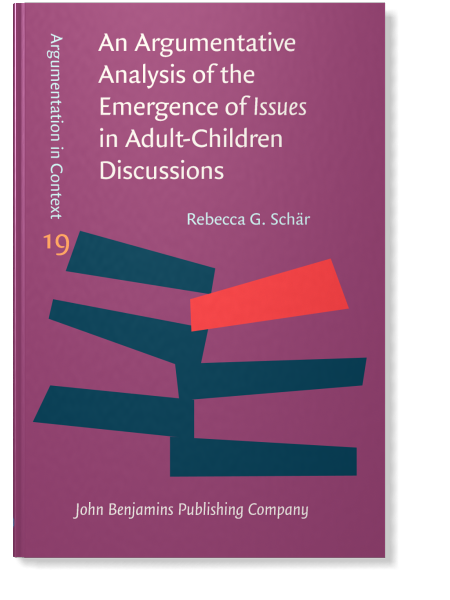
In:An Argumentative Analysis of the Emergence of Issues in Adult-Children Discussions
Rebecca G. Schär
[Argumentation in Context 19] 2021
► pp. 1–7
Young children as rational interlocutors
A perspective on family argumentation
Published online: 6 April 2021
https://doi.org/10.1075/aic.19.c00
https://doi.org/10.1075/aic.19.c00
Article outline
- Understanding young children’s argumentation: An introduction by means of an anecdote
- Some notes for future research
- Advances in contextualized argumentation
- The opening of argumentative issues
Notes References

References (26)
Baumtrog, M. (2018). Navigating a necessary inequality: Children and
knowledge-based injustice. Alternative Routes: A Journal of Critical Social
Research, 29, 294–294.
Bose, I., and Hannken-Illjes, K. (2016). Wie Vorschulkinder Geltung etablieren. Acta Universitatis Wratslaviensis Studia Linguistica, XXXV(3742), 119–136.
Bova, A., and Arcidiacono, F. (2013). Investigating children’s why-questions: A study comparing
argumentative and explanatory functions. Discourse Studies, 15(6), 713–734.
Cigada, S. (2000). Nomi e cose: Aspetti semantici e pragmatici delle strutture
nominali. Milan: Educatt, available at: [URL] (last visited: October 2020).
Convertini, J. (2020). An interdisciplinary approach to investigate preschool
children’s implicit inferential reasoning in scientific
activities. Research in Science Education, .
Eemeren, F. H., van, and Snoeck Henkemans, A. F. (2017). Argumentation: Analysis and evaluation (second edition). New York/London: Routledge.
Fasulo, A. & Pontecorvo, C. (1994). “Sì, ma questa volta abbiamo detto la verità”. Le
strategie argomentative dei bambini nelle dispute
familiari. Rassegna Di Psicologia, 3(XI), 83–101.
Goodwin, J. (2002). Designing issues. In van Eemeren, F. H. and Houtlosser, P. (Ed.), Dialectic and rhetoric: The warp and woof of argumentation
analysis (pp. 81–96). Dordrecht: Kluwer Academic Publishers.
Greco, S. (2018). Designing dialogue: Argumentation as conflict management
in social interaction. Tranel – Travaux Neuchâtelois de Linguistique, 68, 7–7.
Greco, S., Mehmeti, T., and Perret-Clermont, A.-N. (2017). Do adult-children dialogical interactions leave space for
a full development of argumentation? A case study. Journal of Argumentation in Context, 6(2), 193–219.
Greco, S., Perret-Clermont, A. N., Iannaccone, A., Rocci, A., Convertini, J., and Schär, R. (2018). The analysis of implicit premises within children’s
argumentative inferences. Informal Logic, 38(4), 438–470.
Hauser, S. & Luginbühl, M. (2015). Aushandlung von Angemessenheit in
Entscheidungsdiskussionen von Schulkindern. Aptum, Zeitschrift Für Sprachkritik Und Sprachkultur, 11(2), 180–189.
Iannaccone, A., Perret-Clermont, A.-N., and Convertini, J. (2019). Children as investigators of Brunerian “possible worlds”.
The role of narrative scenarios in children’s argumentative
thinking. Integrative Psychological and Behavioral Science, 53(4), 679–693.
Jackson, S. (2015). Design thinking in argumentation theory and
practice. Argumentation, 29(3), 243–263.
Jacobs, S., and Jackson, S. (1981). Argument as a natural category: The routine grounds for
arguing in conversation. The Western journal of Speech Communication, 45, 118–118.
Lewinski, M., & Mohammed, M. (2016). Argumentation theory. In K. B. Jensen & R. T. Craig (Editors-in-Chief), J. D. Pooley & E. W. Rothenbuhler (Associate Editors). The International Encyclopedia of Communication Theory and
Philosophy (pp. 1–15). Hoboken, New Jersey: JohnWiley & Sons.
Migdalek, M. J., Santibáñez Yáñez, C. and Rosemberg, C. R. (2014). Estrategias argumentativas en niños pequeños: Un estudio
a partir de las disputas durante el juego en contextos
escolares. Revista Signos. Estudios de Lingüística, 47(86), 435–462.
Muller Mirza, N., and Perret-Clermont, A.-N. (2009). Argumentation and education, theoretical foundations and
practices. New York: Springer.
Perret-Clermont, A.-N. (2015). The architecture of social relationships and thinking
spaces for growth. In C. Psaltis, A. Gillespie, and A.-N. Perret-Clermont (Eds.). Social relations in human and societal development (pp. 51–70). New York: Palgrave Macmillan.
Perret-Clermont, A.-N., Schär, R., Greco, S., Convertini, J., Iannaccone, A., and Rocci, A. (2019). Shifting from a monological to a dialogical perspective
on children’s argumentation: Lessons learned. In F. H. van Eemeren and B. Garssen (Eds.), Argumentation in actual practice: Topical studies about
argumentative discourse in context (pp. 211–236). Amsterdam/Philadelphia: John Benjamins.
Pontecorvo, C., and Arcidiacono, F. (2007). Famiglie all’italiana: Parlare a tavola. Milano: Raffaello Cortina.
Rapanta, C., Garcia-Mila, M., and Gilabert, S. (2015). What is meant by argumentative competence? An integrative
review of methods of analysis and assessment in
education. Review of Educational Research, 83(4), 483–520.