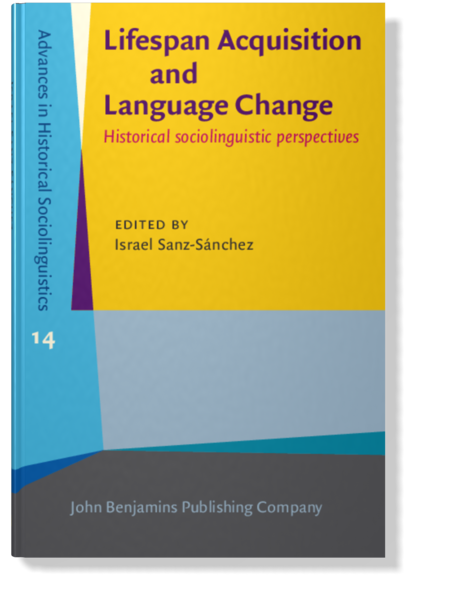
In:Lifespan Acquisition and Language Change: Historical sociolinguistic perspectives
Edited by Israel Sanz-Sánchez
[Advances in Historical Sociolinguistics 14] 2024
► pp. 318–326
Chapter 13Towards an acquisitionally informed historical
sociolinguistics
Published online: 4 April 2024
https://doi.org/10.1075/ahs.14.13san
https://doi.org/10.1075/ahs.14.13san
Abstract
This conclusion chapter offers an overview of
some of the main themes developed throughout the volume and
highlights several important theoretical and methodological
implications for the development of new acquisitionally informed
research agendas in historical sociolinguistics. The use of
acquisition theory and corpora as sources of information to
interpret the sociohistorical and sociolinguistic archive is
complicated by several methodological and analytical hurdles –
nevertheless, it is argued here that acquisitional analogues between
past and present and a knowledge of how various groups of learners
process different forms of variation can do much to propel the study
of language variation and change in historical situations. In
addition, new technological developments and sources of data can
furnish researchers additional information about how individual
acquisitional trajectories may have contributed to the linguistic
patterns attested in the archival record. Lastly, an acquisitionally
informed perspective can also be a step to address structural
inequalities in linguistic description and in the construction of
knowledge in our field.
Article outline
- 1.What lies ahead? Language acquisition across the lifespan and future research agendas in historical sociolinguistics
- 2.What’s needed? Challenges and opportunities
References

References (16)
Anthonissen, Lynn & Peter Petré. 2019. Grammaticalization
and the linguistic individual: New avenues in lifespan
research. Linguistics
Vanguard 5(2). 20180037.
Baxter, Gareth & William Croft. 2016. Modeling
language change across the lifespan: Individual trajectories
in community change. Language
Variation and
Change 28. 129–173.
Canagarajah, Suresh. 2013. Translingual
practice: Global Englishes and cosmopolitan
relations. London: Routledge.
Centre for English
Corpus
Linguistics. 2022. Learner
corpora around the world. [URL] (15 January
2022)
CHILDES. 2022. Child
language data exchange system. [URL] (15 January
2022)
McShane, Marjorie & Sergei Nirenburg. 2021. Linguistics
for the age of AI. Cambridge, MA: The MIT Press.
Nevalainen, Terttu, Tanja Säily & Turo Vartiainen (eds). 2020a. Comparative
sociolinguistic perspectives on the rate of linguistic
change. Special issue of
the Journal of Historical
Sociolinguistics, 6(2).
Nevalainen, Terttu, Tanja Säily, Turo Vartiainen, Aatu Liimatta & Jefrey Lijffijt. 2020b. History
of English as punctuated equilibria? A meta-analysis of the
rate of linguistic change in Middle
English. Journal of
Historical
Sociolinguistics 6(2). 20190008.
Operstein, Natalie. 2015. Contact-genetic
linguistics: Toward a contact-based theory of language
change. Language
Sciences 48. 1–15.
Petré, Peter & Freek Van de Velde. 2018. The
real-time dynamics of the individual and the community in
grammaticalization. Language 94(4). 867–901.
Trudgill, Peter. 2011. Sociolinguistic
typology: Social determinants of linguistic
complexity. Oxford: Oxford University Press.