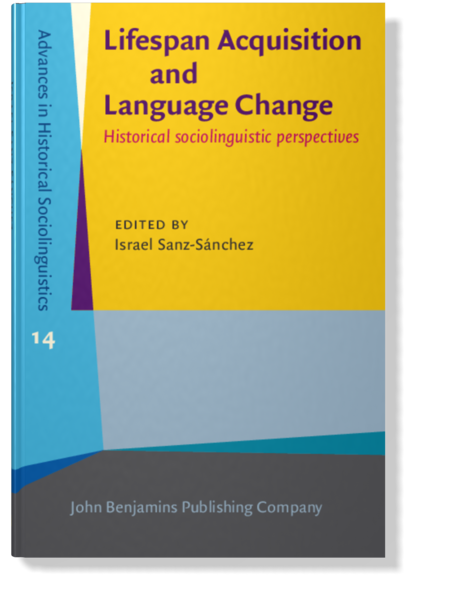
In:Lifespan Acquisition and Language Change: Historical sociolinguistic perspectives
Edited by Israel Sanz-Sánchez
[Advances in Historical Sociolinguistics 14] 2024
► pp. 294–316
Chapter 12Adult L2 acquisition of for-complementation in
Chinese Pidgin English and Hong Kong English
A sociohistorical perspective
Published online: 4 April 2024
https://doi.org/10.1075/ahs.14.12li
https://doi.org/10.1075/ahs.14.12li
Abstract
This paper examines the emergence of
for-complementation in Chinese Pidgin English
(CPE) and Hong Kong English (HKE) from a sociohistorical
perspective. Although CPE and HKE arise under different contact
situations and time periods, surprisingly speakers of these
varieties show parallelism in the use of for to
introduce purposive clauses. The origins of for as
a complementizer in CPE will be argued to be contributed by
convergence of meanings and functions in Cantonese and English – the
major input languages in the feature pools of both varieties. It
will be shown that L2 learning provided the mechanism for the
emergence of for in purposive clauses in CPE and
HKE. Variation in sentential complementation in these two varieties
of English supports one of the tenets in variationist historical
sociolinguistics, namely synchronic and diachronic variation can
inform and complement each other.
Article outline
- 1.Introduction
- 2.Chinese Pidgin English: Historical background
- 3.Verb complementation in CPE
- 3.1Juxtaposition
- 3.2For-complementation
- 3.3To-complementation
- 4.Variable use of complementizers in CPE
- 5.Origins of for as a complementizer in CPE
- 6.Verb complementation in Hong Kong English
- 7.Language acquisition and the historical sociolinguistics of for-complementation
- 8.Conclusion
Acknowledgements Notes Abbreviations References

References (69)
Adone, Dany. 1994. The
acquisition of Mauritius
Creole. Amsterdam: John Benjamins.
Baker, Philip. 1990. Off
target? Journal of Pidgin and
Creole
Languages 5. 107–119.
Baker, Philip & Peter Mühlhäusler. 1990. From
business to pidgin. Journal
of Asian-Pacific
Communication 1(1). 87–115.
Baker, Philip. 2003a. CPE1:
Corpus of Chinese Pidgin English as attested in English
language sources
(1721–1842).
. 2003b. CPE2:
Corpus of Chinese Pidgin English as attested in English
language sources
(1843–1990).
Bickerton, Derek. 1980. Decreolization
and the creole
continuum. In Albert Valdman & Arnold Highfield (eds.), Theoretical
orientations in creole
studies, 109–128. New York: Academic Press.
Bolton, Kingsley. 2002. Hong
Kong English: Autonomy and
creativity. Hong Kong: Hong Kong University Press.
Byrne, Francis. 1984. Fi
and fu: Origins and functions in some Caribbean
English-based
Creoles. Lingua 62(1–2). 97–120.
Census and
Statistics
Department. 2016. Population
by-census – main
results. Hong Kong: Hong Kong Special Administrative Region.
Chan, Alice Y. W. 2004. Syntactic
Transfer: Evidence from the Interlanguage of Hong Kong
Chinese ESL Learners. The
Modern Language
Journal 88, 56–74.
Chappell, Hilary. 2008. Variation
in the grammaticalization of complementizers from Verba
Dicendi in Sinitic
languages”. Linguistic
Typology 12. 45–98.
Escure, Geneviève. 2009. Is
serialization simple? Evidence from Chinese Pidgin
English. In Nicholas Faraclas & Thomas Klein (eds.), Simplicity
and complexity in creoles and
pidgins, 109–123. London: Battlebridge.
Fanning, Edmund. 1924. Voyages
and discoveries in the South Seas,
1792–1832. Salem (Mass): Marine Research Society.
Gisborne, Nikolas. 2009. Aspects
of the morphosyntactic typology of Hong Kong
English. English
World-Wide 30(2). 149–169.
Hall, Jr. Robert A. 1944. Chinese
Pidgin English grammar and
texts. Journal of the
American Oriental
Society 64(3). 95–113.
Heine, Bernd & Tania Kuteva. 2004. World
lexicon of
grammaticalization. Cambridge: Cambridge University Press.
Hernández-Campoy, Juan Manuel & Juan Camilo Conde-Silvestre (eds). 2012. The
handbook of historical
sociolinguistics. London: Blackwell-Wiley.
Hopper, Paul & Elizabeth Traugott. 2003. Grammaticalization (2nd
edition). Cambridge: Cambridge University Press.
Hsin, Ai-li. 2012. The
acquisition of English complementizers in canonical vs.
noncanonical
structures. Taiwan Journal of
TESOL 9. 95–141.
Jenkins, Lawerence Waters (ed.). 1944. Bryant
Parrott Tilden of Salem, at a Chinese dinner party, Canton,
1819. Princeton: Princeton University Press.
Kachru, Braj. 1992. The
other tongue: English across
cultures. 2nd
edition. Urbana, IL: University of Illinois Press.
Kortmann, Bernd, Kerstin Lunkenheimer & Katharina Ehret (eds.). 2020. The
Electronic World Atlas of Varieties of
English. Zenodo. [URL] (15 December
2021).
Lefebvre, Claire & Virginie Loranger. 2006. On
the properties of Saramaccan FU: Synchronic
and diachronic
perspectives. Journal of
Pidgin and Creole
Languages 21. 275–335.
Lefebvre, Claire & Isabelle Therrien. 2015. On
the properties of Papiamentu
pa. In Claire Lefebvre. Functional
Categories in Three Atlantic Creoles. Saramaccan, Haitian
and
Papiamentu, 245–282. Amsterdam: John Benjamins.
Li, Michelle. 2011. Origins
of a preposition: Chinese Pidgin English
long and its implications for pidgin
grammar. Journal of Language
Contact 4(2). 269–294.
. 2017. The
emergence of so as a complementizer in
Chinese Pidgin
English. English
World-Wide 38(1). 5–28.
Li, Michelle & Stephen Matthews. 2016. An
outline of Macau Pidgin
Portuguese. Journal of Pidgin
and Creole
Languages 31(1). 141–183.
Li, Michelle, Stephen Matthews & Geoff Smith. 2005. Pidgin
English texts from The Chinese and English
Instructor. Special
issue of the Hong Kong Journal of
Applied
Linguistics 10. 79–167.
Loines, Elma (ed). 1953. The
China trade post-bag of the Seth Low family of Salem and New
York. Manchester (Maine): Falmoth Publishing House.
Matthews, Stephen & Michelle Li. 2013. Chinese
Pidgin
English. In Susanne Michaelis, Philippe Maurer, Martin Haspelmath & Magnus Huber (eds.), Survey
of pidgin and creole languages. Volume I: English-based and
Dutch-based
languages, 206–213. Oxford: Oxford University Press.
Mufwene, Salikoko. 1989. Equivocal
structures in some Gullah complex
sentences. American
Speech 64(3). 304–326.
O’Shannessy, Carmel. 2020. How
ordinary child language acquisition processes can lead to
the unusual outcome of a mixed
language. International
Journal of
Bilingualism 25. 458–480.
. 2008a. Creoles
as interlanguages: Syntactic
structures. Journal of Pidgin
and Creole
Languages 23(2). 307–328.
. 2008b. Creoles
as interlanguages: Inflectional
morphology. Journal of Pidgin
and Creole
Languages 23(1). 109–130.
Romaine, Suzanne. 2005. Historical
sociolinguistics/Historische
Soziolinguistik. In Ulrich Ammon, Norbert Dittmar, Klaus Mattheier & Peter Trudgill (eds.), Sociolinguistics/Soziolinguistik:
An international handbook of the science of language and
society/Ein internationales Handbuch zur Wissenschaft von
Sprache und
Gesellschaft, volume 2, 1696–1703. Berlin: De Gruyter Mouton.
. 2016. The
variationist
approach. In Merja Kytö & Päivi Pahta (eds.), The
Cambridge handbook of English historical
linguistics, 19–35. Cambridge: Cambridge University Press.
Romasanta, Raquel P. 2019. Variability
in verb complementation: Determinants of grammatical
variation in indigenized L2 varieties of
English. Studies in
Variation, Contacts and Change in
English vol. 20. [URL] (20 January
2022)
Ruschenberger, William Samuel. 1838. Narrative
of a voyage around the world, during the years 1835, 36, and
37;
(...). 2 vols. London: Richard Bentley.
Rutten, Gijsbert & Marijke van der Wal. 2014. Letters
as loot. A sociolinguistic approach to seventeenth and
eighteenth-century
Dutch. Amsterdam: John Benjamins.
Schneider, Edgar. 2007. Postcolonial
English: Varieties around the
world. Cambridge: Cambridge University Press.
Setter, Jane, Cathy Wong & Brian Chan. 2010. Dialect
of English: Hong Kong
English. Edinburgh: Edinburgh University Press.
Shi, Dingxu. 1993. Learning
Pidgin English through Chinese
characters. In Francis Byrne & John Holm (eds.), Atlantic
meets the
Pacific, 459–465. Amsterdam: John Benjamins.
Siegel, Jeff. 2000. Substrate
influence in Hawai’i Creole
English. Language in
Society 29(2). 197–236.
. 2007. Recent
evidence against the Language Bioprogram Hypothesis: The
pivotal case of Hawai’i
Creole. Studies in
Language 31(1). 51–88.
Tagliamonte, Sali A. 2012. Variationist
sociolinguistics: Change, observation,
interpretation. Malden, MA: Wiley-Blackwell.
Tilden, Bryant. 1831–1832. Journal
of fourth voyage to China, in ship Crusoe of Salem via
Batavia, Singapore and
Manila. Unpublished manuscript.
Tilden, Bryant P. 1834–1836. Journal.
Sixth voyage to China, in Ship Surat
1834–1836. Unpublished manuscript.
van Gelderen, Elly. 1998. For
to in the history of
English. American Journal of
Germanic Language and
Literature 10(1). 45–72.
Washabaugh, William. 1975. On
the development of complementizers in
creolization. Working papers
on language
universals 17. 109–140.
. 1980. From
preposition to complementizer in Caribbean English
Creole. In Richard R. Day (ed.), Issues
in English Creoles: Papers from the 1975 Hawaii
conference, 97–109. Amsterdam: John Benjamins.
Weinreich, Uriel, William Labov & Marvin Herzog. 1968. Empirical
foundations for a theory of language
change. In Winfred Lehmann & Yakov Malkiel (eds.), Directions
for historical
linguistics, 95–188. Austin: University of Texas Press.
Winford, Donald. 1985. The
syntax of fi complements in Caribbean
English
Creole. Language 61(3). 588–624.
Wong, May. 2017. Hong
Kong English: Exploring lexicogrammar and discourse from a
corpus-linguistic
perspective. Basingstoke: Palgrave Macmillan.
Yeung, Ka-Wai. 2006. On
the status of the complementizer waa6 in
Cantonese. Taiwan Journal of
Linguistics 4. 1–48.
Yiu, Yuk Man Carine. 2005. Spatial
extension: Directional verbs in
Cantonese. PhD
thesis. Hong Kong University of Science and Technology.