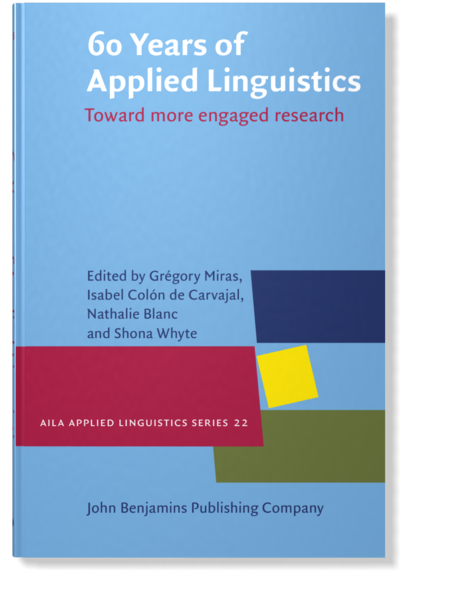
In:60 Years of Applied Linguistics: Toward more engaged research
Edited by Grégory Miras, Isabel Colón de Carvajal, Nathalie Blanc and Shona Whyte
[AILA Applied Linguistics Series 22] 2026
► pp. 116–125
Get fulltext
Chapter 7‘Real people’s concerns’
Paradigm shifts in Applied Linguistics through AILA
Available under the Creative Commons Attribution-NonCommercial-NoDerivatives (CC BY-NC-ND) 4.0 license.
For any use beyond this license, please contact the publisher at rights@benjamins.nl.
Published online: 9 March 2026
https://doi.org/10.1075/aals.22.07why
https://doi.org/10.1075/aals.22.07why
Abstract
This article draws on written and oral exchanges between the authors in preparation for a video
capsule series celebrating key figures in AILA history at the 2023 Lyon Congress. Diane Larsen-Freeman’s work on the
nature of language and the learning and teaching of language needs no introduction: here we focus on three aspects of
the field where her contribution has been particularly impactful. The first part of the chapter considers the ‘social
turn’ in applied linguistics and Larsen-Freeman’s analysis of the important contribution to this new direction by
Firth and Wagner (1996, 1997).
Second, we examine the development of the domain of research known as complex dynamics systems theory (CDST) in
collaboration between Larsen-Freeman and colleagues de Bot, Lowie, and Verspoor in the Netherlands. The final section
of the chapter reflects Larsen-Freeman’s concern throughout her career for humanist aspects of aims and methods in
applied linguistics and the relevance of this approach to questions of diversity and inclusiveness in today’s complex,
interconnected world.
Article outline
- Introduction
- 1.The social turn in applied linguistics
- 2.Complex Dynamic Systems Theory
- 3.A humanist approach to Applied Linguistics
References

References (29)
Atkinson, D. (2002). Towards
a sociocognitve approach to second language acquisition. The Modern Language
Journal, 86(4), 525–545.
Bailey, N., Madden, C., & Krashen, S. (1974). Is
there a “natural sequence” in adult second language learning? Language
Learning, 21(1), 235–243.
Cameron, L., & Larsen-Freeman, D. (2007). Preview
article: Complex systems and applied linguistics. International Journal of
Applied
Linguistics, 17(2), 226–240.
De Bot, K., Verspoor, M., & Lowie, W. (2005). Dynamic
systems theory and applied linguistics: The ultimate “so what”? International
Journal of Applied
Linguistics, 15(1), 116–118.
Doughty, C. J., & Long, M. H. (Eds.). (2003). The
handbook of second language
acquisition. Blackwell.
Ellis, N., & Larsen-Freeman, D. (2005, July). Language
emergence. Symposium presented at the 14th AILA
World Congress, Madison, WI.
Ellis, N. C., & Larsen-Freeman, D. (2006). Language
emergence: Implications for Applied Linguistics. Applied
Linguistics, 27(4), 558–589.
Evans, J. (2007). The
emergence of language: A dynamical systems
account. In E. Hoff & M. Shatz (Eds.), Blackwell
handbook of language
development (pp. 128–148). Blackwell.
Firth, A., & Wagner, J. (1996, August). On
discourse, communication, and (some) fundamental concepts in SLA
research [Conference presentation]. 11th AILA
World Congress, Jyväskylä, Finland.
(1997). On
discourse, communication, and (some) fundamental concepts in SLA research. The
Modern Language
Journal, 81(3), 285–300.
Gregg, K. (1990). The
variable competence model and why it isn’t. Applied
Linguistics, 11(4), 364–383.
Herdina, P., & Jessner, U. (2002). A
dynamic model of multilingualism: Perspectives of change in
psycholinguistics. Multilingual Matters.
Larsen-Freeman, D. (1975). The
acquisition of grammatical morphemes by adult ESL students. TESOL
Quarterly, 9(4), 409–430.
(1976). An
explanation for the morpheme acquisition order of second language
learners. Language
Learning, 26(1), 125–134.
(1997). Chaos/complexity
science and second language acquisition. Applied
Linguistics, 18(2),141–165.
(2007). Reflecting
on the cognitive–social debate in second language acquisition. The Modern
Language
Journal, 91(1), 773–787.
(2017). Complexity
theory: The lessons continue. In L. Ortega & Z. H. Han (Eds.), Complexity
theory and language development: In celebration of Diane
Larsen-Freeman (pp. 11–50). John Benjamins.
(2021, August). From
the “What ifs” to the “So what’s”: Updating our understanding of second language development from a complex
dynamic systems perspective. Keynote presented at
the 19th AILA World Congress, Groningen,
Netherlands.
(2024). Lessons
learned. In E. Milak, & A. Tankosić (Eds.), Becoming
a linguist: Advice from key thinkers in language
studies (pp. 36–48). Taylor & Francis.
Larsen-Freeman, D., & Cameron, L. (2008). Complex
systems and Applied Linguistics. Oxford University Press.
Milak, E., & Tankosić, A. (Eds.). (2024). Becoming
a linguist: Advice from key thinkers in language studies. Taylor & Francis.
Milon, J. (1974). The
development of negation in English by a second language learner. TESOL
Quarterly, 8(2), 137–143.
Ortega, L., & Han, Z. (Eds.). (2017). Complexity
theory and language development: In celebration of Diane Larsen-Freeman. John Benjamins.
Ravem, R. (1974). The
development of Wh-questions in first and second language
learners. In J. Richards (Ed.), Error
analysis (pp. 134–144). Longman.